

“Uneven Care in Co-Presence”
Heidi Mikkola (University of Turku)
The Tale of Silyan, directed by Tamara Kotevska, draws on a Macedonian folktale in which a disobedient son is transformed into a stork. This reference quietly frames the film from the outset, casting a narrative shadow over what follows. The story we see – which follows a farmer whose life becomes increasingly marked by absence after his family leaves for Germany – is grounded in a contemporary rural setting, shaped by economic strain and migration, yet it remains in dialogue with this older narrative structure. Only later does an injured stork enter his everyday life. Focusing on this relationship between the farmer and the bird, the film moves between observation and suggestion, between what unfolds in front of the camera and what is implied.
At first glance, the situation appears simple: a man cares for an injured animal, and a bond develops through proximity and routine. But the presence of the folktale complicates this reading. The stork carries with him the echo of a transformed son. Even though the relationship develops gradually, there is a sense that the bird’s meaning is partly prefigured. This creates a subtle tension between the film’s observational surface and the narrative framework that surrounds it. The stork is both a bird and something more symbolic, and the film never fully settles on how it should be understood.
Because of this, the relationship between the farmer and the stork does not entirely register as open-ended. There is a feeling that the bird has been given a role in advance, one that risks narrowing how we interpret his presence. Following Maria Puig de la Bellacasa (2017), care can be understood as a more-than-human process that exceeds intentional reciprocity, emerging through relations and attachments not reducible to human agency. From this perspective, the folktale framing risks pulling the relationship back into a human-centered logic, positioning the stork as a substitute for familial care. At the same time, the film’s commitment to observation, such as attention to small gestures and everyday routines, keeps the relationship grounded in the ordinary. The farmer and the stork share space and time, and even a form of vulnerability, but not in the same way. Their lives intersect without ever quite aligning, and the film allows this unevenness to remain visible.
This tension becomes more pronounced through the film’s pacing. Much of The Tale of Silyan is built around watching and waiting. The camera lingers on minor actions: feeding, standing, observing, returning. The film does not push toward resolution but instead holds the viewer within an extended present. Small changes, like a shift in the stork’s movement, a variation in the farmer’s routine, take on weight without being dramatized.
This way of seeing creates a sense of openness, but it is also structured by the conditions of the relationship itself. The stork is visible because it has been brought into proximity with the human, and because that proximity is sustained through care. Attention, in this sense, is not neutral. The bird is not simply encountered as he is also, in a way, kept within reach, both of the farmer and the camera. The film does not foreground this as a problem, but it does make it perceptible through repetition, through the return to the same spaces and gestures that hold the relationship in place. Waiting operates in a similar way. Both the farmer and the stork are, in different ways, suspended. The stork cannot migrate, while the farmer remains within an economic situation that offers little possibility for change. These forms of waiting overlap, but they are not the same. It is through this sustained attention that care comes into focus. Care always involves intervention, sustaining life while also shaping the conditions under which that life unfolds.
In The Tale of Silyan, the stork’s survival depends on this care, but that survival is inseparable from a growing dependency and human-centeredness. The longer the relationship continues, the more the bird’s life becomes tied to human rhythms. The bird does not return to his migratory path but instead he remains, increasingly integrated into the farmer’s everyday world. The relationship begins to resemble something closer to domestication. The stork is no longer fully wild but not entirely domesticated either. It occupies an in-between position, sustained within a human-centered arrangement.
What links the farmer and the stork most clearly is a shared exposure to forces beyond their control. The film’s landscape, where agriculture, waste, and survival intersect, makes this visible without emphasizing it directly. There is a sense that both human and nonhuman life are being reshaped by broader conditions that remain largely off-screen. Care becomes one of the few available responses within this situation, even if it cannot address its underlying causes. Yet this shared vulnerability does not erase difference. The farmer retains some capacity to navigate his circumstances, however limited, while the stork’s possibilities are far more restricted. Their co-presence does not resolve this imbalance. If anything, it makes it more apparent, precisely because the film remains so closely attuned to their everyday interaction.
By the end, it no longer feels necessary to hold onto the folktale metaphor in any fixed way. What becomes more compelling is not what the stork stands for, but how it lives alongside the farmer within the conditions the film observes. The folktale does not disappear, but recedes into one possible layer of meaning rather than a guiding structure. In this sense, the film shifts attention away from symbolic resolution and toward care—how it is practiced, how it binds, and how it remains uneven even in its persistence. Yet, the film does not present care as a solution. Seeing, waiting, and staying function as ways of holding the relationship open, without forcing it into a narrative of harmony or redemption. The film’s restraint feels deliberate in this regard. It avoids the kinds of closure that might make the relationship easier to interpret. What remains is a relationship that is intimate but uneven, sustained yet unresolved. The Tale of Silyan does not offer a model for how humans and nonhumans might live together. Instead, it stays with the more difficult task of showing what such coexistence looks like when it unfolds under constraint, and when care itself becomes part of the tension rather than a way beyond it.
“Landscape, Precarity, and Non-Anthropocentric Interiority”
Dijana Jelača (Brooklyn College, CUNY)
In the region of former Yugoslavia, a notable cinematic trend has emerged in recent years—one that has been labeled “landscape cinema.” Consisting predominantly of documentaries, these films probe human connections to the environment, the land, animals, and nature writ large. Oftentimes, they are about the conflict between tradition and modernization, peace and violence, the old and the new. They are also about precarious and often annihilating neoliberal capitalist realities that have wreaked havoc on the local industries and livelihoods in the wake of the disintegration of socialist Yugoslavia in 1991 (of which North Macedonia – then the Republic of Macedonia – was a constitutive part). Tamara Kotevska’s The Tale of Silyan (2025) is no exception to this trend.
Many of the documentaries belonging to the landscape cinema oeuvre have been directed or co-directed by women, including Kotevska’s previous Honeyland (co-directed with Ljubomir Stefanov, 2019), which won an award at Sundance and was nominated for two Academy Awards. Other examples include Homelands (Jelena Maksimović, 2020, Serbia), Disturbed Earth (Kumjana Novakova, 2021, Bosnia/North Macedonia), At the Door of the House, Who Will Come Knocking (Maja Novaković, 2024, Bosnia/Serbia), and another recent Sundance award-winner, To Hold a Mountain (co-directed by Biljana Tuturov and Petar Glomazić, 2026, Montenegro).
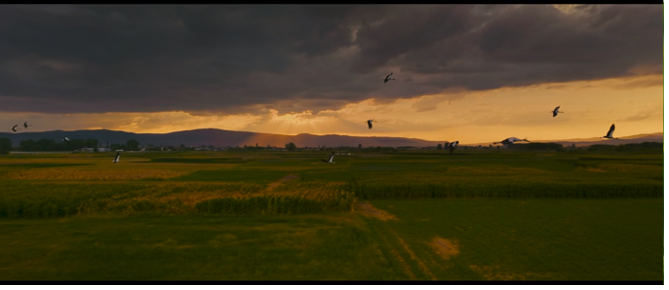
The Tale of Silyan depicts the harsh conditions and diminishing returns that local farmers increasingly contend with and protest against. Set in the village of Češinovo, which has the largest white stork population in North Macedonia, the film chronicles the co-habitation of humans and animals, marked by mutual respect in a seemingly tranquil environment. As the villagers work the land, the storks participate by finding sources of food in the newly plowed ground. Yet, not everything is as idyllic as the film’s stunning cinematography might initially suggest. The farmers are struggling under neoliberal precarity, seeing dwindling sales and a steep lowering of prices for their produce. The film is a chronicle of the growing difficulties of sustaining traditional forms of farming in the face of capitalist exploitation and hyper-production, with which local farmers cannot adequately compete.
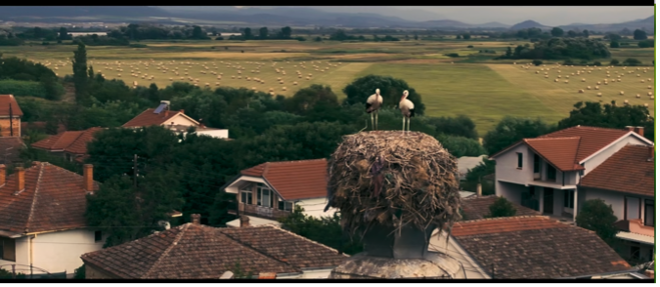
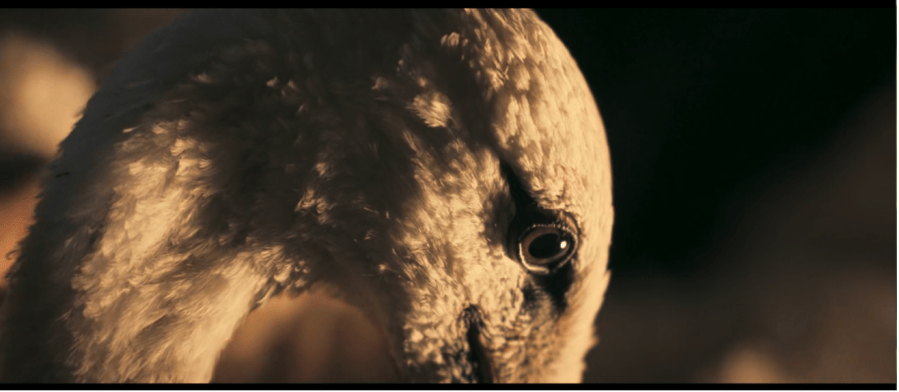
Punctuating this drama are the omnipresent storks, reminders of the cycles of life and continuity in the face of difficulty. The film opens with a close-up of a stork’s head being stroked by a man’s hand. The bird’s eye is central to the frame, as if the very opening shot of the film is inviting us to consider the bird’s point of view and the interiority of a non-human entity—its strangeness and the impossibility of knowing of what it’s really like to be non-human.
The film centers Nikola, a middle-aged farmer, as we are told in voiceover narration Silyan’s tale, a mythical story of a human boy who grew up in a village but did not want to continue the tradition of working the land. Angered, his father cursed him by asking that he be turned into a bird, and Silyan became a stork. The parable is both old and of its time—reflecting the dilemma between abandoning tradition or continuing to fight for it in the face of challenges. How can the sustainability that the farmers—and the birds—work so hard to maintain be, in fact, sustained? There are no easy answers, as the film implies.
The documentary intersperses the story of the farmers with sequences that focus solely on the storks, depicting them in their glorious avian strangeness, as they clap their beaks to produce rhythmic sounds—possibly a language—inaccessible to human understanding. Here the film balances between the human drama and the non-anthropocentric modes of representation. At the same time, clear parallels are drawn between the economic migration of many Macedonians to western Europe (Nikola’s wife, daughter and grandchildren all leave for Germany), and the storks migrating south to ensure steady food supplies during winter. Here the mythical story of Silyan is yet again a poignant link—caught in between, Silyan, just like Nikola, wants to stay in his native village but is called upon to migrate out of necessity. The storks increasingly suffer under the conditions of capitalist ecocide, in which the fields where food was once grown are now waste landfills. Images of fresh farm produce and healthy birds are replaced by animal carcasses and toxic waste in the second half of the film, which also sees Nikola give up on farming and take employment with the waste collection company. In an exercise of deep respect, farmers bury dead birds and mark their graves.
At this point Nikola discovers an injured stork with a broken wing and takes care of it. The human-bird connection is wordless and tender. Through it, Nikola reconnects to the nature and the land. The non-human friend appears to have silently influenced the human’s decision to give up on selling his land and instead go back to farming. Importantly, the film does not attempt to anthropomorphize the wild bird. Silyan remains a mysterious, mythical presence, just like in the old folk tale. The film suggests that animals – particularly wild ones – can be a powerful reminder to the humans of the precious natural balance and humans’ role in respecting and sustaining it. It might be an uphill battle, but the film ends on a cautiously optimistic note that sees Nikola back in the field, surrounded by storks who do their part in the cycle of precarious yet sustainable life.

