

“The Suspension of Time”
Filipe Martins (University of Porto)
The title of Ross McElwee’s most recent film, Remake, does not allow us to anticipate its main theme. In fact, as in some of his previous works, the title refers to a secondary narrative thread: in this case, the potential development of a fictional adaptation of his documentary Sherman’s March by a Hollywood studio. In Sherman’s March (1985), McElwee’s true focus had not exactly been General Sherman’s military campaign during the American Civil War, but rather the director’s own meandering in search of a new romantic partner while developing his autobiographical documentary. And in Remake (2025), the theme of the potential cinematic remake feels merely incidental. It is as if McElwee makes a point of setting the anchor somewhere on the periphery, far from the true thematic center, in order to emphasize the contingent and wandering tone of his cinematic tapestries.
Or perhaps the title is also intended to function as a kind of euphemism, because the film deals, in fact, with the most violent of themes: the death of a child. Remake orbits around the death of Adrian, the filmmaker’s son, whose image as a newborn was introduced in Time Indefinite (1993). For a spectator like me, reasonably familiar with McElwee’s work, the euphemism of the title intensified the impact of the tragic revelation delivered in the very first minutes. Learning of Adrian’s unexpected death was a profound shock to me, rarely felt in my experience with cinema. Immediately, the several decades of personal and family life that McElwee had documented so intimately in his previous films resonated differently, rewiring all the connections across his body of work.
Time Indefinite, which explored the director’s anxieties about fatherhood and death, suddenly assumed a disturbingly premonitory tone. Even more so than in Photographic Memory (2011), where the evolution of the father-son relationship occupies a central axis, it is in Time Indefinite (1993)—whose timeframe is almost entirely prior to Adrian’s birth—that the deepest resonance is felt. At a certain point in that film, as we watch a sequence featuring several shots of children’s graves in a Mexican cemetery, McElwee comments in voice-over: “I’m not exactly sure what fuels my hesitation on having kids… I know it’s absurd to worry about something happening to a child who has not even been conceived yet, but sometimes I think this might be part of my problem.” From this film onwards the camera begins to assert itself as a weapon to combat the inexorable flow of time, death, and the hollowing out of memory. McElwee continues: “I also find myself becoming more and more obsessed with death in general. It’s drawing a shadow on everything: life, work, family. The idea of family especially haunts me, and I keep thinking there must be some way to deal with this through my filming.” And, further on, he adds: “Over the last fifteen years, I edited and reedited this footage I shot of my family… Maybe I’ve been trying to preserve things in the present, somehow keep everyone alive in some sort of time indefinite.”
The insoluble problem that McElwee has consciously faced since Time Indefinite is that, on the one hand, the movie camera seems to function as a magnifying glass that allows one to expand time, returning each of its moments to the proximity of the present; but, on the other hand, the camera is also an instrument of distancing, a performative mechanism, a filter that refracts and defers the real, relegating it to a place where fiction and the representation of the past tend to blur.
In fact, the images captured by the lens help make reality more bearable at the cost of fictionalizing it. While McElwee films his own arm during a blood draw in Time Indefinite, he remarks: “If I watch it through a lens, it seems less real to me, more like I’m watching a movie.” But this capacity of the lens to exchange the real for the performativity of the real can turn into an unwanted renunciation, a kind of betrayal of reality that the passage of time, moreover, tends to amplify. McElwee expresses this frustration several times in his films. In Remake, referring to the footage of his son: “My fear now is that, by looking at this footage over and over again, things will slowly start shifting into making you seem like a fictional character. Someone who never existed except on film.”
Nevertheless, despite the impossible struggle against the vortex of time, McElwee continues to produce images. In Bright Leaves, reflecting on his compulsion to film his son, he comments: “I keep filming him as he gets older here – collecting more and more footage – as if the sheer weight of all of these accumulated images could somehow keep him from growing up so fast, slow the process down.” Naturally, the filmmaker knows this is a lost cause: “Of course, filming doesn’t slow anything down.” On the contrary, the accumulation of the archive might even produce an illustration of time’s disconcerting speed. The effect of juxtaposition between past and present described by Jaimie Baron as the “archive effect” tends, in fact, to emphasize temporal disparity and heighten the awareness of the entire ocean of time that has suddenly passed between two juxtaposed shots. This is what we may feel when, in Remake, McElwee retrieves old footage of people who participated in his earlier films and juxtaposes it with current footage of these same aged participants. Faced with these combined images, we may find ourselves wondering how time has passed so quickly.
Another way of relating images to time has to do with suspension. It involves a way of seeing whose effect is the crystallization of time, the eternalization of the moments time holds. Here, images do not necessarily betray the real; on the contrary, they can even increase its visibility, like magnifying lenses, even if (or precisely because) these images reach us through the performative filter of art.
McElwee films with the intention of suspending time, and he does so without any naïveté, because his gaze is, above all, aesthetic. In Time Indefinite, while presenting us with old footage of his parents, he describes: “For me, there is something about the images themselves. It is the way everything seems to shimmer in the light of that particular, ordinary Sunday morning. The way everything is in movement, the shadows, the light, the handheld camera… Everything is sort of quivering with the kind of life that would be very hard to reenact.” There is nothing naive or fallacious in the realization of this strange liveliness, of this profound sensoriality of the images. It is a very peculiar form of realism, a strictly aesthetic authenticity that only the poetic impulse truly knows how to grasp, yet this does not render such images any less anchored in the real.
Admittedly, the real appears to us irresistibly more whole in the present. In Remake, where the narration is addressed directly to his son, McElwee notes: “Looking at this now, you seem as alive as ever in a kind of half-life that now represents you. You’re alive here in this footage, but you’re no longer alive in the real world.” Ultimately, everything that is no longer in the present runs the growing risk of becoming unreal, nonexistent, fictional. But the “real world” McElwee refers to cannot be reduced to the criterion of presence, if only because, ultimately, the present is impossibly elusive. In truth, the real persists secretly in the recorded moments of the past, emancipated from the historical chronology of time itself, eternalized in a “time indefinite.” And, if we know how to look, it becomes possible to access and inhabit it through the aesthetic power of images. Such is, undoubtedly, a profound conviction of McElwee’s. Eternity—or “time indefinite”—is a time separated from actuality, the possibility of the real emancipated from the present.
In a passage in Bright Leaves (2003), McElwee muses in voice-over: “I sometimes imagine my son, years from now, when I’m no longer around, looking at what I’ve filmed. I can almost feel him looking back at me from some distant point in the future… through these images and reflections, through the film I’ll leave behind.” Such a scenario, unfortunately, will no longer come to pass. Yet, in one of the most memorable moments of Remake, McElwee reflects on a sequence of footage Adrian had captured while skiing. From Adrian’s own first-person perspective, we see him glide down an improvised path until he stops in a small clearing among the trees, alone somewhere in the middle of the mountain. McElwee comments: “When I saw this footage, it was suddenly like being able to inhabit your body.” For a few moments, we continue to see the surrounding scenery from the perspective of Adrian’s helmet as he catches his breath. We hear nothing else but his heavy breathing. McElwee’s narration continues: “When you were a little boy and while we were skiing together, we’d sometimes stop just to listen to how quiet it was. I wonder if that’s what you were doing here.” Gradually, we lend Adrian our body and he lends us his. We listen together to the surrounding silence and relive this eternalized moment.
“A Culmination”
Efrén Cuevas (University of Navarra)
Fifteen years after Photographic Memory (2011), Ross McElwee has released Remake (2026), a clear continuation of his previous work and, to a certain extent, a culmination of his career. McElwee offers us a narrative that spans approximately the past two decades of his life using his classic film diary structure, in which he draws on his personal experiences to also comment on the evolution of American society.
The film draws its title from Hollywood’s endeavors to adapt his influential documentary Sherman’s March (1986). This thread acts, in a way, like a MacGuffin, which gradually loses significance as the story of his son Adrian takes center stage. From the beginning, McElwee addresses Adrian in voiceover while we watch home movies featuring his son, creating a poignant dialogue between voice and image. McElwee informs us early in the film of his son’s death, which occurred in 2016 due to a fentanyl overdose. From that point on, the film becomes a portrayal of the filmmaker’s grief—a difficult process of coming to terms with his son’s death—which lends the film its most enduring characteristic.
McElwee constructs this film in his usual style, handling both camera and sound himself, filming scenes with an unhurried observational cadence, leaving room for life to unfold before the camera. One might think he is shooting home movies, since his subjects are everyday scenes and his protagonists are his family and friends. But they are being shot by a professional filmmaker and often end up becoming part of his films; thus, they possess an ambiguous nature, in that they are not intended solely for family viewing.
At the same time, McElwee observes these images from the present—as marked by the voiceover—projecting a retrospective gaze characteristic of the autobiographical perspective, which endows the images with a temporal dimension they would not have as a mere “diary”—a common feature of the autobiographical documentary cinema that McElwee has so masterfully cultivated. These “home movies” constitute, then, a valuable family archive, to which the filmmaker returns to find answers, to explore the motivations of his late son, and to try to bring him “back to life”—as he also stated in Time Indefinite (1993) regarding the footage he had filmed of his father in the past. Film’s mnemonic power thus comes to the forefront, while it is simultaneously called into question, in an unstable balance between life and death—the life present in those images and the death that cut short Adrian’s life when he was only 27 years old.
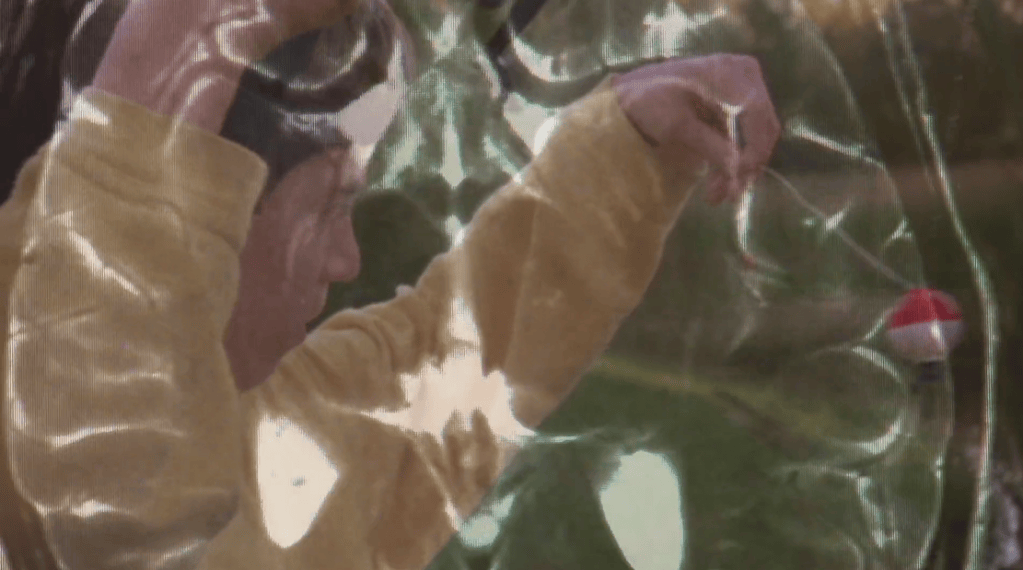
Memory also takes center stage in the unexpected montage sequences that appear in Remake. Unexpected because McElwee’s entire filmography had previously relied on that unique blend of observational visual style—with long takes and unobtrusive editing—and autobiographical perspective, conveyed through his voiceover narration. One might surmise that this new direction stems from the presence—also a first in his filmography—of a co-editor, Joe Bini. In one such sequence, McElwee uses medical resonance imaging that reveals a large tumor in his brain, for which he must undergo surgery, as a visual filter through which we see scenes from various periods featuring his children or his father. Once again, memory and death are in dialogue; once again, home movies serve as reliquaries of memory, as scholar Lourdes Esqueda so aptly put it. This theme resonates once more when he interviews his friend Charlene—a central character in many of his films—who can no longer remember those times because she suffers from Alzheimer’s.
McElwee gives shape to the portrait of his son using footage he has recorded over the years, conversations between the two that he also filmed, and footage shot by Adrian himself. At times, the film gives access to an intimacy within this father-son relationship that can make us feel like intruders, as when we hear the conversation between them in a bedroom in Colorado, with his son revealing openly his problems with drugs, which may make us question why it is being filmed. One could argue that this is a common strategy for McElwee, who builds his films from everyday scenes he has been recording over the years. But here one might wonder if it wouldn’t have been more appropriate to turn off the camera, as Charlene once urged him to do in Sherman’s March in a different context. Yet it is also true that Ross McElwee knows how to frame these more intimate scenes within a context that gives them meaning—a context built on respect, affection, and pain. This meaning transcends his son’s personal struggles, making them serve as a lens through which to observe U.S. society and, in particular, the opioid epidemic ravaging the country.
Remake can be read as a culmination of McElwee’s career, not only because he released this film at the age of 78 but also because it encapsulates, in a way, the filmmaker’s entire body of work—his themes, his characters, his concerns—viewed through his unique perspective and distinctive style. He explains this approach to his son in one scene, noting that he doesn’t appear much on screen because people aren’t interested in seeing him, but rather in seeing the world through his eyes. In this film, McElwee presents us with a condensed version of the world he has lived in for decades, permeated by the inconceivable pain of a father grappling with the loss of his son. And along the way, he revisits and delves deeper into the major themes of his filmography, resulting in a dense film with layers that accumulate and interact with one another. This film, then, appears to bring to a close—at least for now—a body of work that has left a profound mark on autobiographical cinema to date.


Hello. Before seeing this documentary, I was unfamiliar with McElwee’s work, but I enjoyed seeing a glimpse of his filmmaking process and how it tied into his relationship with his family. It is hard to grapple with the severity of untimely death in a way that isn’t entirely oppressive, but I think that Ross does well with this film. It would be rude to diminish this film’s captivating draw by calling it “entertainment,” but I think that mixing heavy topics like this with the wonder of childhood and memory makes its message more digestible. Though the world may contain great suffering, the reason why we confront our faults in order to continue living and creating is because of the great appreciation of our world, big and small.
This film is very valuable, and I will start looking into McElwee’s other works 🙂
LikeLike
Hi. This was such a tremendous documentary. I think the ways in which life is wound up together in an overarching narrative can be sometimes hard to imagine and/or confront–how is it that you can only really understand something from the other side? How is it that all of these little threads, personal moments–things people say in passing become so heavy they anchor the entire film? I mean, even Charleen’s presence in the film sticks out to me. The rumination of memory/remembering is so poignant that even simple shots of Adrian at times are hard to bear. When McElwee childs Adrian for asking to film him on that rooftop, saying that people want to see his perspective and not him–I think he does misunderstand that seeing his perspective will always mean seeing him, the subjective lens of the camera means that all the footage we see both from McElwee and Adrian is them, maybe differently from when they are directly in front of the camera, but nonetheless it is hard not to feel wrapped up in the moment McEwlee successfully creates (I think here of his comments on footage of his parents). I think often of what Tim O’Brien said in his book The Things They Carried, that Story truth can sometimes be more real than Happening truth or as put simply by Joan Didion “We tell ourselves stories in order to live.” It is always a drive to explain yourself and your environment and I am fascinated by McEwlee’s struggle with if the softer, happier story he created for his son in Photographic Memory is what eventually killed him. The entire issue of having to create but understanding in a way your own limits and or shortcomings in the realm of true, fact, is captivating. This film is sickening in it’s effectiveness and a masterclass on the demonstrative power of film. It is a veil through which we are able to share with McEwlee his happiest and saddest moments with his son. Wow.
LikeLike
Thanks for these posts. Here’s my reflection and then a couple questions for more discussion:
I’ve long admired McElwee’s work and have seen roughly half his output. Most would agree that REMAKE is the ‘hardest watch’ of his oeuvre. Here as elsewhere, McElwee’s filmmaking is so obsessive, self-focused, and down-to-earth that it almost veers into feeling like ‘just’ edited home movies that an amateur could also make, but this is often mitigated and elevated by McElwee’s sensitive and searching voice-over-narration. Even in the passages where he is not able to yield that much of interest (either visually or verbally) I appreciated the fact that he includes material shot to mark the time: for example filming a city woodchipper taking care of some trees across the street. This certainly isn’t Scorsese’s “pure cinema,” but something much more modest: a visual diary might be the best way to put it.
One uncomfortable aspect of REMAKE is the disjuncture between Ross and Adrian regarding their taste in filmmaking and the meaning that it brings to their lives, both collectively and individually. Ross himself is a bit of a melancholic eccentric who is able to make better peace with his life when also viewed in the ‘objective’ mode. (This difference in personality between him and his female friends–who exhort him to ‘feel’ more and film less–was the source of humor in SHERMAN’S MARCH) Ross and Adrian are tense collaborators when Ross invites him to festivals or has Adrian ‘help’ with filming occasionally. Adrian’s short films also are very much the opposite of his fathers–wild and self-indulgent parties, biking, or skiing films. They are only interesting to watch in the context of a father trying to make sense of his son and what makes him tick. Ross only half-understands him–largely because it also seemed Adrian also only half-understood himself–and is left to reconstruct what is left of both an eventually ruined life along with many clear and good memories (which also always appeared as filmed footage).
I appreciated Martins’ citation of this moment in Bright Leaves: “I sometimes imagine my son, years from now, when I’m no longer around, looking at what I’ve filmed. I can almost feel him looking back at me from some distant point in the future… through these images and reflections, through the film I’ll leave behind.” The imagined legacy and archive of work is disrupted here as Ross’ imagined place in the family timeline is disfigured by his son’s early passing. His montage of the jumbled, out-of-order footage in REMAKE (just after Adrian passes) captures this well. Here, he says “the story of lives lived over decades is now disjointed confused. The reels are all out of order. Something goes awry, something goes off-script and then, suddenly, you’re gone.” The blur between films and lives also conceived as “order” and “script” is interesting here.
I’d modify what Cuevas says in the second essay about REMAKE as the “culmination” of Ross’ career and the “inconceivable pain” of losing the son. I’d say–given Ross’ searching, earnest narration that this does feel more like a reconsideration of his career than a culmination. The difficulty of the film is not just its reckoning with the tragic loss but that it causes Ross to revisit his primary mode of working and, above and beyond this, interacting with life and others–genuinely asking what good came of it. It is obvious by the end that much good came of Ross’ work but I take the sincerity of his feeling of shatteredness and uncertainty at face value as well. The film, then, is also his best attempt to make that pain “conceivable” and the stand-out moments of the film such as the skiing voice-over analyzed above and Adrian’s strange poem (which does not make sense and in another way does, according to his voice-over) capture the uncanny and poignant feeling of the father’s loss as well as he can. We are left trusting that Ross made his best attempt to make sense of all this and is sharing what is translatable at all as best as he can–as well as the loose threads that still haunt him.
A couple more things to think about–
Ross plays with the tension between the narrative coherence of film as such (that works within the framework of a logical, linear cause-and-effect chain) and the vast, open-ended, and uncertain formless quality of life itself. By telling us that Adrian would die at the outset–and updating us when the time was down to one-year–a chronology and an inevitability is established, but what is also so painful to Ross of course is that this outcome was not necessarily inevitable. How do we reconcile the slippage between was does happen with the assumption that it must or had to have happened? Does cinema as a storytelling medium encourage a sense of cause-and-effect certainty in particular? I’d argue that this mode of thinking is maybe even more default in our everyday communication with others and that cinema can model an alternative: psychologically deep, non-linear sensations of time and experience that are still communicable to others. REMAKE models self-presentation and self-understanding in a non-linear but still conceptually coherent work.
The film also leaves us with the question of how different we are from Ross ourselves. He’s on the high-end of self-documenting obsessiveness, but as a prior commenter pointed out, we are increasingly living this way ourselves in the Instagram era. We are left to consider if this is a degree in different or kind: is Ross documenting how most or many of this ‘process’ or lives or is he an exceptional outlier in needing or liking to use the camera and video so much to better understand his experiences? Are our memories often also photographs or videos? How do we make sense of our raw memories versus memory that we have curated and archived? Perhaps it is Ross’ thoughtful, sensitive voice-over that is most unique about him now–and less the meticulous visual-documentation of time spent with family and friends.
LikeLike
Thanks for your comments. It is quite interesting what you say. Not sure to what extend there is a connection between McElwee’s films and the current blurring of private and public lives, but it makes sense to see some correlation. When you say “There is a social cost —especially to young people I think —when life is primarily performative,” you are pointing to a real challenge? problem?
Efrén Cuevas
LikeLike
I’ve always appreciated McElwee’s work. But it seems to me that his unrelenting focus on his personal life has unintentionally led the way to 24/7 influencers who create content to brand themselves. What seems authentic in McElwee has resulted in the elimination of distinctions between private and public. There is a social cost —especially to young people I think —when life is primarily performative. And there seems to have been a personal cost to McElwee and his family. The filming seems to have had negative consequences on his divorce. His children and new wife no longer want to be video fodder. (All to see this reflects my choice to have rarely taped my kids. They may miss recorded memories, but I always felt more present when choosing not to shoot.)
(I feel similarly about how Wiseman’s path breaking direct cinema became the bastard child reality tv. And now there is a bizarre doc –You Can See Everything– that premiered at Telluride that seems to be upending the subject/filmmaker relationship. https://www.nytimes.com/2026/09/07/movies/elizabeth-holmes-documentary-nathan-fielder-a24.html)
Seeing how the subjects of Sherman’s March and McElwee have aged hit a chord for me. It was reminiscent of the 7 UP series. Like McElwee and like many of us aging folk, I’m more focussed on re-working the past than documenting the present. Maybe it’s in part because my future horizon is so limited and the larger prospects seem so bleak.
LikeLike