

“Solidarity Makes Union Strong”
Joseph Clark (Simon Fraser University)
As I write this essay, Amazon workers at the warehouse near my home in Vancouver, British Columbia have just successfully gained recognition for their union. Amazon will surely appeal and possibly close its facility altogether (as it has done elsewhere when faced with successful unionization efforts), but for now the warehouse workers in Delta, BC are only the second Amazon shop represented by a union. The first is JFK8 – the fulfillment center on Staten Island, New York that voted to unionize under the auspices of the independent Amazon Labor Union in 2022. JFK8, the ALU, and its charismatic leader, Christian Smalls, are the subjects of Brett Story and Stephen Maing’s compelling documentary, Union (2024).
I mention this context for a couple of reasons. First, it is a reminder that the push to unionize the workplaces of post-industrial capitalist mega-corporations like Amazon continues – and that companies like Amazon will use any means at their disposal to thwart those efforts. Second, it underlines the fact that, despite their focus on a particular organizing effort on Staten Island and the personalities involved in that campaign, Story and Maing also aim to describe a much larger issue: the conflict between workers and corporations under late-stage capitalism (or perhaps what Yannis Varoufakis calls techno-feudalism). That broader struggle stretches from the warehouses and fulfilment centers of New York and British Columbia to the factories of Asia, the mines of the Democratic Republic of Congo, and the online shopping carts and personal devices gathering our data.
Story and Maing announce their ambitions from the very opening of the film: a durational shot of a huge cargo ship stacked high with containers lumbering slowly across the frame. The shot references the cover image of Alan Sekula’s Fish Story (1989 – 1995) – a photographic essay that uses the world’s oceans as a means to represent and examine global capitalism, and which Story cites as an influence. Like Sekula’s work, the cargo ship image – contrasted as it is with Amazon workers piling onto overcrowded buses and arriving on Staten Island in the darkness of the very early morning – reminds the viewer that this local battle is part of a broader conflict, and that Amazon and its workers are part of a system of supply chain capitalism in which we are all implicated.The impulse to cast the struggle for the ALU in a wider political and economic context is consistent with Story’s previous films. The Prison in Twelve Landscapes (2016) maps the wide-reaching impacts of carceral culture without showing a prison on screen. The Hottest August (2019) examines climate change obliquely through people, places, and the anxieties that hang thick in the air of New York City in the long aftermath of Hurricane Sandy. Both films depict systemic forces by focusing on their everyday impacts on people. Through an essayistic use of tableau and multi-vocality, Story rejects traditional narrative approaches and their focus on strong central characters.
Indeed, in her essay for World Records, “How Does It End? Story and the Property Form,” Story argues that narrative – especially as it has been commodified by the documentary industrial complex of funders, distributors, and broadcasters – runs counter to the kind of political filmmaking to which she aspires. “The story form… does useful work for capital recuperation precisely because it dovetails with the individualism at the heart of neoliberal capitalism and the property form alike. The hero, the resilient individual, the villain, the charity case: these are all variations on an already existing and pernicious ideological preference for the individual over the social, the “character” over the condition, experience over consciousness.” According to Story, the best political films are about systems rather than individuals.
But the systems-based analysis that Story deploys so successfully in The Hottest August and The Prison in Twelve Landscapes is tested by the clear, character-driven story in Union. The unionization effort provides an unavoidable narrative arc culminating in the vote to certify the union. Smalls’ dynamism and leadership means that there is at least one strong character. And the film shows the diversity of voices within the union movement. There is Angelika Maldonado, the quiet but committed new recruit; Natalie Monarrez, who lives in her car despite working at Amazon for years; Madeline Wesley, the idealistic college graduate brought in by the union to “salt” the Amazon building with organizers; and Jason Anthony, AKA the transit guru, who can tell you the details of all his colleagues’ hours long commutes to work. But it is Smalls who commands most attention on screen and in the movement. As one prospective union member reminds us, he is “low-key famous” and the film – and the movement – must contend with this growing celebrity.
Early in the film Smalls himself recounts how the Amazon Board discussed a public relations strategy of foregrounding his personality and leadership in order to delegitimize the unionization effort. He says to his comrades, “The top general counsel for Amazon said that I’m not smart or articulate and to make me the whole face of the unionizing efforts… [That way] they would be in a better PR position. They said to ‘make Smalls the most interesting topic.’”
Despite Smalls’ celebrity, Union does show a multi-faceted picture of the organizing effort, the grueling pace of Amazon warehouse work, and the algorithmic surveillance that is a constant part of workers’ lives. We see many of the union members at home, with their families, and on their commutes. Hidden camera footage of so-called “training sessions” featuring anti-union propaganda and a dramatic confrontation where Amazon security and police physically remove union organizers demonstrate the extent to which the company will go to thwart the unionization effort.
The film also does not shy away from the tensions within the union. We see the shared commitment of the organizers come up against the fissures of class, age, and race within their ranks. In sometimes tense Zoom meetings, we get a sense of simmering resentment at Smalls’ leadership. Monarrez ultimately leaves the union before the vote, decrying the ALU “boys club” atmosphere and arguing that workers need to join a more experienced national organization to achieve their goals. Even after the successful vote at JFK8, defeats at other Amazon facilities lead union members to question the strategy of expanding the certification drive. But even in these scenes Smalls remains at the center of the frame.
Individualism, and its emphasis on empathy, has its political limits. “Solidarity,” as Story argues in World Records, “is more capacious, and thus more radical.”
Ultimately the film and the union movement face the same dilemma: how to build solidarity for Amazon workers? The film concludes with the words of an unnamed ALU organizer at the Amazon ONT8 Fulfillment Center in Moreno Valley, California. She gathered her co-workers and said, “let’s try to unionize, because that’s the only way we are going to get them to listen to us. That’s where our power is going to come from: unionizing.” Her voice reminds the viewer that the struggle for worker’s rights is much bigger than one warehouse or one individual. Organizing – like the political filmmaking Story champions – is about systems.
“Disrupting Amazon”
Emmelle Israel (UCLA)
Amazon employs over 1.5 million workers worldwide, yet their labor practices evaded public reckoning for decades. There is a broader history of global worker activism against Amazon’s labor exploitation, but 2019 marked the beginning of US-based Amazon workers openly organizing walkouts and strikes to coincide with Amazon’s Prime Day. Their actions contributed to a change in public narratives about working conditions at Amazon. Union (2024), co-directed by Brett Story and Stephen Maing, captures a critical moment in that broader cultural shift by following the organizers who led the campaign to unionize Amazon’s JFK8 warehouse in Staten Island. Despite the perception that Amazon is a domain of advanced technologies such as robotics, algorithms, artificial intelligence, and automation, its e-retail operations are still contingent upon human labor and physical machinery that are housed in massive fulfillment centers. By focusing on the day-to-day efforts of Amazon Labor Union (ALU) organizers leading up to the union election, Union provides a compelling glimpse at what it takes to enact broader change in the face of overwhelming workplace oppression.
Most workers in the US do not have firsthand experience in unionizing their workplace or being a union member. Convincing people they have the power to make demands of their employer and win is one of the principal obstacles to overcome in an organizing campaign. Though media coverage and popular portrayals typically highlight the most dramatic elements of labor-management conflicts, scenes in Union tend toward small details and personal interactions. The documentary begins with the ALU already collecting signatures to hold a union election at their workplace. We learn about inciting issues for the campaign—overwork and negligent health and safety protection for warehouse workers in the wake of the pandemic—as ALU organizers and JFK8 workers connect during the pockets of time between the workday and the daily commute. There are more intense moments as the election campaign concludes, but quotidian scenes of early morning flyering and contentious late night meetings emphasize the daily grind that makes a larger victory possible.
Story and Maing use contextualizing elements such as text overlays or interviews sparingly, so much of the storytelling in Union comes from conversations ALU organizers have amongst themselves and with other workers. Workers’ stories become powerful testimonies that can move their coworkers, their communities, and the general public to support their cause. Union demonstrates this when ALU organizers disrupt a captive audience meeting. One of the new hires initially writes off the union organizers as “rude” but ends up supporting ALU after an organizer shares that it has been three years since his last raise and poor working conditions at the company have not improved. Though in-person conversation is prioritized as the most important form of communication for many union campaigns, digital organizing is also featured as a key part of ALU’s efforts. The video grid of Zoom’s meeting interface features in several scenes, and ALU leader Chris Smalls’ Twitter and Instagram accounts are key platforms for spreading information about Amazon’s anti-union efforts to supporters outside of the warehouse. For contemporary organizing efforts, sharing worker stories online cannot be dismissed as secondary.
Union also foregrounds the ways that Amazon’s digital success relies on the corporeal stress and strain of underpaid workers. Even before workers clock in, they undergo the physical effort of commuting to JFK8. Shots of public transit and time spent traveling to work recur as transitions between scenes in Union. One of the few direct to camera interviews in the film features Jason, an Amazon worker and Amazon Labor Union (ALU) organizer dubbed “the transit guru” by fellow organizers. Standing in front of a map of the NYC subway system, Jason shares stories of how some people commute over two hours to JFK8. While workers are not compensated for it, commute time is a considerable part of the workday for many of them. There are also several shots throughout the film of groups of people taking an MTA bus to the JFK8 fulfilment center. The camera does not linger too long on people’s faces, but the range in age, race, and gender of the workforce at JFK8 is evident. As reflected by the leadership of ALU, JFK8 largely employs Black and Latine workers. Amazon points to its commitment to diverse hiring as evidence of its positive values as an employer, but the reality of workplace discrimination at Amazon undermines that spin. Though not a central focus of the documentary, ALU organizers talk about being passed over for promotions based on their gender and race, emphasizing how workers’ bodies are evaluated. Lastly, sites of transit—the bus stop, the parking lot, the sidewalk—are key settings for many of the organizing conversations throughout the film.
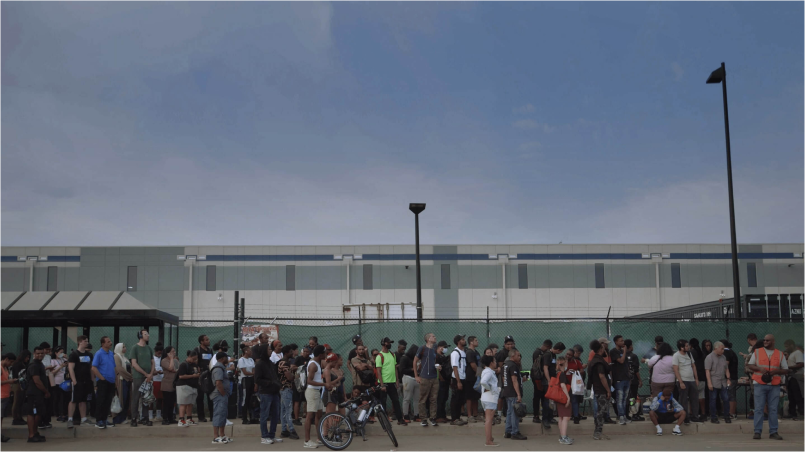
The open-ended conclusion of the film underscores the fact that even after an impressive victory in the union election at JFK8, there is more to be done. As a company engaged in the business of online commerce, logistics, surveillance, and data collection, Amazon is pervasive in the US and other countries where its products and services have spread. Amazon is in our environment and in our bodies as the company’s popularization of nearly instant shipping drives increasing air pollution, carbon emissions, and packaging trash. Amazon also shapes culture beyond consumer habits with its investment in film and TV production and ownership of the livestreaming platform, Twitch. Additionally, the company controls nearly a third of the worldwide cloud computing market, and millions of people reportedly use Amazon’s virtual assistant Alexa or own a device with it installed. Amazon’s omnipresence and significant political influence means that short-term changes and long-term decisions at all levels of the company directly and indirectly impact everyday life for hundreds of millions of people. Still, seeing ALU take decisive action in Union is a reminder that the ambient presence of Amazon in all our lives can be disrupted, and that organizing gives everyday people the means to leverage their power against circumstances that seem insurmountable in the current moment.
 DOCALOGUE