

“Growing Up in Latvia”
Zane Balčus (Latvian Academy of Culture)
When thinking about youth in Latvian documentary cinema, the most vivid example can be found several decades ago in Juris Podnieks’ film Is It Easy to Be Young? (Vai viegli būt jaunam?, 1986), which shook the society of perestroika time and whose resonance, like ripples on water, reached far beyond Latvia’s borders (at the time, not even an independent country). Podnieks managed to draw out openness from his characters, which was unusual in the Soviet context. He spoke to them as equals, and their responses expressed deep disappointment and hopelessness about their future prospects living in the USSR. During this same period of perestroika and national awakening, Ivars Seleckis’ Crossroad Street (Šķērsiela, 1988) captured the atmosphere of the national revival era and the pages of Latvia’s historical tragedies inflicted by Soviet occupation, subjects that filmmakers were finally able to start addressing. This powerful work brought the filmmakers a series of significant awards, including the Felix Award for Best European Documentary Film.
Notably, Crossroad Street led to two subsequent follow-up films made in the same location in 1999 and 2013. Thus, the 2024 film To Be Continued. Teenhood (a collaboration between Seleckis and Armands Začs, who was also editor on Seleckis’ 2018 film To Be Continued) marks Seleckis’ second experience in making a longitudinal documentary. It features the same characters, filmed seven years later, whom Seleckis had documented in To Be Continued when they were first graders. The idea of revisiting the same characters after a certain period was announced already at the release of To Be Continued.
Characters in Teenhood are just slightly younger than the ones in Is It Easy To Be Young?, but there is a huge divide between them in terms of the issues they address, the lives they live, and the prospects they have: living in Dubai or Nice, studying abroad, playing basketball in Italy, for example. The five protagonists of Teenhood come from different parts of Latvia, and their environments, families, and interests vary widely, creating distinct stories. In both To Be Continued and Teenhood, a single school year serves as the organizing framework for the story, with a clear beginning and end. Within this structure, the personalities, interests, daily lives, family situations, and details of current life in Latvia emerge. This includes, for example, parents working abroad and leaving children behind with grandparents and how this effects further family dynamics, as well as the beginning of Russia’s full-scale invasion in Ukraine that we hear in the news in the background.
We can see in this film the recurring features of Seleckis’ previous work – that of a director and cinematographer with a sharp and deeply human perspective on people and their stories. His body of work comprises poetic and analytical approaches (in the 1960s), socially driven themes (from the 1970s), and starting with Crossroad Street we can see his profound interest in the people’s stories at a specific moment in time. The focus on children as the main protagonists in To Be Continued was a novel theme for the veteran director Seleckis (born in 1934), who admitted in the film’s opening scene: “I’ve filmed all sorts of things in my life, but this is my first time making a film about children.” Teenhood premiered on the day when Seleckis turned 90 years old.
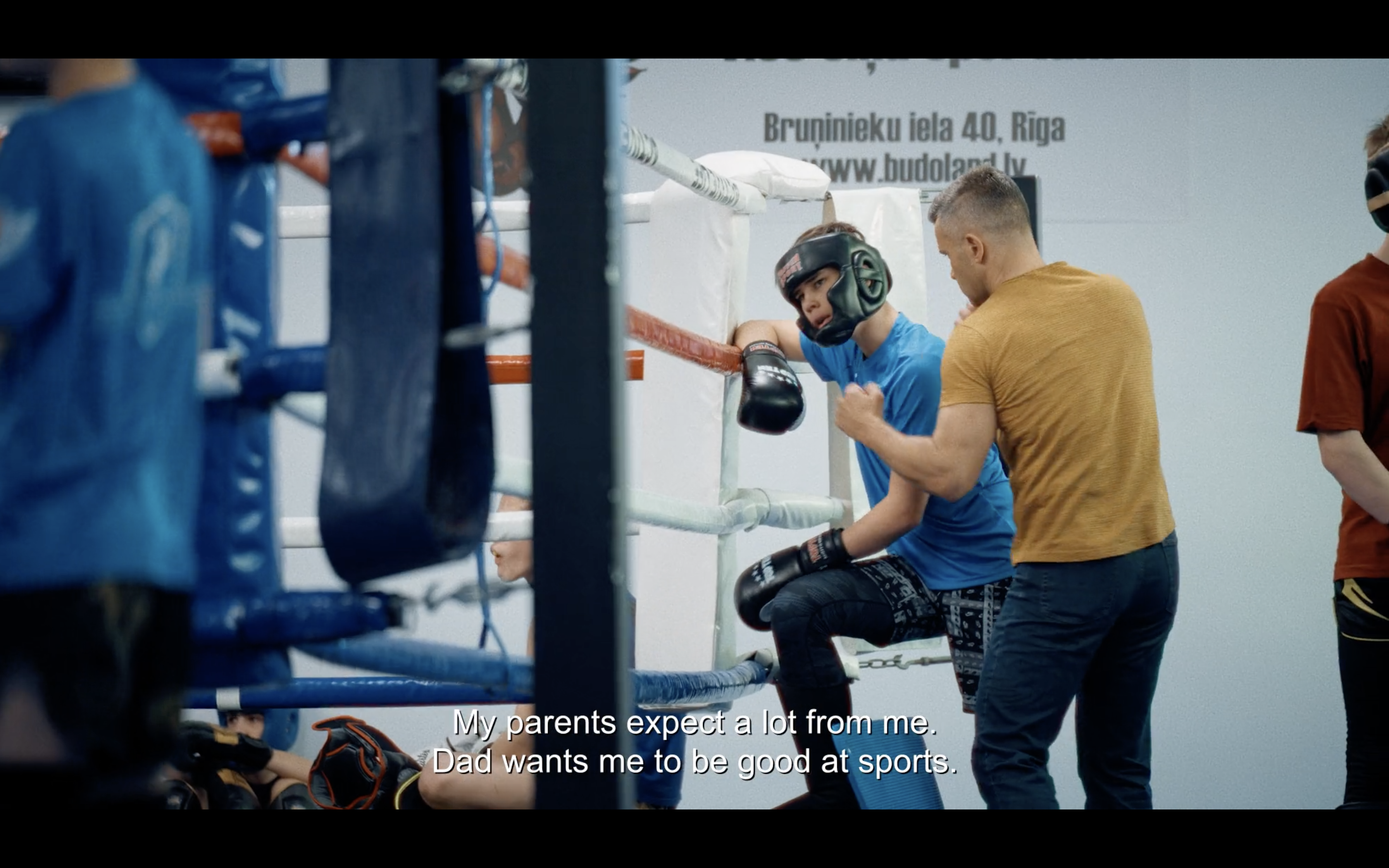
Unlike Seleckis’ previous works, To Be Continued was made without voiceover narration. However, in the opening scene, he is seen on camera and speaks about his personal memories, linking them to the children’s experiences that we will later see in the film. Teenhood, on the other hand, avoids such a direct presence, allowing the protagonists to narrate their own stories, and giving each of them a distinct musical theme, marking their presence on screen aurally. The link between the two films is created through visual connections of recurring scenes in both films: for instance, Kārlis, who lives in the countryside, is seen hammering a nail into a piece of wood. In one scene, he is a small boy struggling with the weight of the hammer; in another, he is seven years older and has grown stronger, though his skills still need refinement. Similarly, Gļebs’ emotions while training in judo and boxing, both then and now, reflect his personality and his father’s influence on his choice of sports. In the first film, Anastasija walks to school along a forest path in winter, an image that evokes a fairy-tale atmosphere – a small girl in a snowy, dark forest. Now, in the later film, this figure is taller and more self-assured. Through this approach, the scenes from the first film feel very closely integrated into the new work, making them not inserts from the past but supports for the scenes of the present.
The longevity of film projects like the Up series (Michael Apted, 1964 – 2019) or The Children of Golzow (Die Kinder von Golzow, Winfried and Barbara Junge, 1961 –2007) demonstrate the appeal for films which document the passing of time and the shifts in biological, biographical, and historical situations of their characters. Also, the filmmakers of To Be Continued face similar challenges: how to approach the ever-growing amount of material, what aspects to choose to document, what materials from previous films to incorporate in each subsequent installment, and so forth. Like other longitudinal documentaries, Teenhood encapsulates both nationally-specific and universal aspects. When watching it locally, the nuances of Latvian society at each particular filming period read differently for the viewer who is not familiar with the context – typical events at schools, rural scenery, media coverage of Russia’s full-scale invasion in Ukraine, and so forth. However, the universal elements – how the lives of the characters evolve, how they look, how they feel – cross over national borders. How this series will evolve stylistically we will see in the subsequent installments, and I hope we will have the chance to witness it and follow the character’s lives.
“Melodrama of Time”
Daniela Zacmane (Latvian Academy of Culture)
The film To Be Continued: Teenhood (2024) had its world premiere on the 22nd of September, the 90th birthday of Latvian film director Ivars Seleckis, who made the film with a director of a much younger generation, Armands Zacs. Seleckis is among the key figures of the Riga School of Poetic Documentary Cinema, which emerged in the 1960s. He has always been deeply interested in individuals—their sense of presence and visions for the future. “In my life, I have filmed all sorts of things, but it’s the first time I’m filming children,” confessed Seleckis in 2018, when the first film in this series, To Be Continued, was released on the big screen. In reality, children have appeared in the director’s films on several occasions (in Salty Life and the Crossroad Street trilogy), but in those, children were more passersby and were rarely allowed to express their thoughts.
The film To Be Continued: Teenhood follows five young people – Anastasija, Anete, Karlis, Glebs, and Zane – who we saw as first-grade schoolchildren in To Be Continued, and who are now adolescents coming of age. In literature, J.D. Salinger, along with filmmakers such as François Truffaut and Louis Malle, demonstrated that coming-of-age narratives can be provocative and sometimes even funny, while eschewing moral judgment.
During the Soviet period, films such as Rita (Ada Neretniece, 1957) and Nauris (Leonīds Leimanis, 1957), which can be categorized as coming-of-age stories, were explicitly instructive. They followed the general narrative models of Soviet cinema. Film scholar Inga Pērkone makes reference to David Bordwell, who identified two schematic patterns in Soviet historical materialism: the “structure of confrontation” and the “structure of apprenticeship.” She concludes that after Latvia regained its independence, the structure of apprenticeship (or of initiation) in which an individual moves from ignorance to knowledge and from passivity to action has completely disappeared from our films. Much more nuanced, empathetic, and emotionally resonant narratives have entered both documentary and feature film. The documentary film Is It Easy to Be Young? (1986) by Juris Podnieks was groundbreaking, setting a new standard for treating teenagers as equals. Coming-of-age narratives in fiction films have become increasingly popular in Latvian cinema over the last decade.
Film scholars such as Linda Williams and Christine Gledhill have extensively explored the concept of the melodrama, emphasizing its function as a narrative and aesthetic framework that transcends genre boundaries. Their work highlights how melodrama operates as a modality, characterized by heightened emotional expression, moral polarization, and a focus on the struggles of individuals within broader social or cultural contexts. Growing up as a period characterized by escalation, fatalism, sharp feelings, and tension fits perfectly into a melodramatic interpretation. The longitudinal documentary genre seems to be inherently embedded in the narrative of these life stages.
The film’s emotional impact is largely achieved in post-production through the integration of footage from To Be Continued. Throughout the film, we repeatedly see each of the five protagonists as children seven years ago. The footage from the previous film reveals glimpses of the past: Gleb training at judo diligently, Zane reluctant to get out of bed in the morning, Anete singing a song online to her mother, who is abroad, Karlis learning to cut a nail, and so on.
The reuse of past footage here serves multiple functions. It allows past events to resonate within the current narrative, enabling viewers to trace the transformative journey from childhood to adolescence by comparing the “then” and “now.” Additionally, it reinforces the concept of a consistent identity, highlighting continuity despite the significant physical changes over time. The integration of the fragments has a huge touching effect, especially for one of the characters – Anastasia.
Teenage schoolgirl Anastasia lives in the Latvian countryside, where her mother breeds horses. In the first film, one of the most beautiful scenes features young Anastasia with the horses. It is a pristine white winter, and a little girl with a school bag on her back stands in a snowy field as three majestic horses run past her. The scene feels like a fairy tale. The pastoral landscape is enchanting, and the bond between Anastasia and her mother exudes a sense of warmth and reassurance, suggesting that everything is, and will remain, just fine. While other classmates have “big dreams,” in one of the episodes Anastasia says: “My character is similar to my mum’s. When I grow up, I’ll still be living in the country.”
Seven years later, everything has changed. The very first shots of the now young-adult Anastasia convey a markedly different tone. She sits alone at a table, with her mother and little brother visible in the background. Soon, she confesses to the camera that she feels lonely and that her mother has been unable to devote time to her because of other responsibilities—the farm and caring for the young child. “There is no one who asks if you are okay,” she admits, her words echoing the weight of her isolation. After some time, the film revisits Anastasia. Her grades have declined. She sings joylessly at the school Christmas concert and walks home alone along a snowy road. These somber scenes are juxtaposed with earlier footage of a young, carefree Anastasia playing with three horses. The past meets the present, and reality confronts the fairy tale.
The concept of time is pivotal in melodramatic storytelling. Among the most common temporal constructs that generate tension and evoke emotional engagement in the audience are the notions of “too late” and “last-minute rescue.” This is a documentary film, not a fiction, so the dramaturgy of time is staged a bit differently, yet there the structure of melodrama still applies.
The words To Be Continued in the titles themselves suggest a consideration of temporality. To Be Continued implies life as an endless process of transformation, with no fixed destination. In contrast, To Be Continued. Teenhood narrows the focus specifically to youth, adolescence, and coming-of-age experiences. Rather, it hints at the common idea of the impermanence of youth—teenhood is a phase, but its influence extends beyond the teenage years. This is where the sense of urgency and anxiety about being “too late” emerges. Tension of time doesn’t make the film a melodrama, but the heightened emotional stakes, exaggerated sense of urgency, and portrayal of teenhood as both fleeting and decisive amplify its melodramatic tone.
In Anastasia’s case, the inclusion of childhood footage creates a confrontation between the happy little girl then and the gloomy teenager now. The clash is further intensified by a later revelation in the film: Anastasia has left her mother and the countryside behind, choosing to move to the city to live with her father. The notion of childhood as the happiest period of life is deeply ingrained in cultural narratives. Childhood is often idealized as a time when the future is full of promise and possibility. However, the challenges and complexities of adolescence disrupt this idyllic precondition, challenging the assumption that a joyful childhood ensures a fulfilling future. However, time categories should be viewed more broadly in the context of the melodrama modality. “At its deepest level melodrama is an expression of feeling toward a time that passes too fast,” writes Williams. Time seems to fly even quicker during easy and carefree periods. The use of childhood footage evokes nostalgia and sorrow, emphasizing how fleeting those happy days are. Meanwhile, the challenges of adolescence add emotional anxiety, as this stage of life feels both turbulent and deeply formative. Adolescence is a period to understand something. Time seems to pass too fast in both cases.
The film ends with this character – Anastasia. She is determinedly going to a new school when the new school year will begin. The viewer is left with the hope that they will meet the characters of the film again and that they will be in a different, lighter stage of live. Meanwhile, at the film’s premiere, Seleckis remarked that a man never truly grows up.
 DOCALOGUE