

“The Humanity of Virtuality”
Michael Grabowski (Manhattan University)
Another director might have titled this documentary The Secret Life of Mats Steen. After all, no one in Steen’s family knew about the relationships he had cultivated online until after his death from Duchenne muscular dystrophy. Steen lived, in a sense, two lives: one physically bound to his motorized wheelchair and another as the hero Ibelin in the massively multiplayer online role-playing game World of Warcraft (WoW). He kept these two lives separate, not revealing his online relationships to his family nor allowing the members of Starlight, the guild to which he belonged in WoW, to visit or video chat with him.
However, Ibelin (Netflix added The Remarkable Life of to preface director Benjamin Ree’s simple title after its purchase at Sundance) is the name of Steen’s avatar. “Remarkable” suggests something worthy of noting, a life lived with purpose. As the film presents it, Steen’s life as lived through Ibelin was more exciting, full of meaningful relationships and imbuing a sense of self-worth through the advice and other assistance he offered to his community.
The film raises two key questions related to identity in the digital age; the first is a question for all of us and the second is for documentary filmmakers themselves. First, are we approaching an era when our virtual selves are as central to who we are as the roles we play in the physical world? Is Steen’s experience unusual because of his disability, or is it a harbinger to a future in which the virtual is our primary form of connection?
Second, what limits, if any, should documentary filmmakers put on creating footage to tell a story? The controversy of using recreations in The Thin Blue Line (Errol Morris, 1988) seems almost quaint in the face of generative AI. Recreations can illustrate key moments, but the compulsion to shape a story to conform to established structures may cloud the reality of “what happened.” Is it enough to assert that anything is permissible as long as generated images convey an emotional truth?
This story serves as countercurrent to the moral panic about video games impacting the socialization of youth. The fashion lately is to blame digital technologies for society’s ills. They are seen as dangers to young people and blamed for causing antisocial behavior and depression. Schools are banning mobile phones within their walls, and parents are encouraged to limit their children’s screen time. Yet, the film reminds us that multiplayer games can be sites where meaningful social exchanges can flourish.
I observed this myself during the pandemic when my school-aged son would jump on our game console every chance he could get. I realized that during these games, he would have deep conversations with his friends despite being separated during lockdown. Like neighbors in the past meeting to play cards, playing the game is merely an excuse to gather together and socialize.
We currently live in a tyranny of the physical. With expressions like “terminally online” and “touch grass” young people are cautioned against spending their youth online. Films like Her (Spike Jonze, 2013) and Ex Machina (Alex Garland, 2014) present dystopian futures in which digital facsimiles of people become preferable to the real thing. Lost in this narrative are the people who use digital technologies not to escape from life but to interact with one another. Like the mother seeking an emotional connection with her autistic son or the artistic teen who develops a close bond with Steen, Ibelin shows how WoW provides a platform for virtual human communication that may be otherwise painful or impossible in physical form.

Ibelin’s structure mirrors its theme: a prologue full of pity juxtaposed against the action and full emotional resonance of the world Ibelin inhabits. A virtual kiss with another player threatens Ibelin’s relationship with Rumour, with whom he has made a soulful connection, before they reconcile and rekindle their romance. A falling out with the guild sets up the ordeal in Ibelin’s hero’s journey. One wonders to what degree the voluminous text chat logs from which this story was reconstructed were shaped into the well-formed story presented here.
The film’s visual style contrasts the muted analogue home video footage of Steen with the vibrant cel animation of Ibelin. While head animators Rasmus Tukia and Ada Wikdahl faithfully represent Ibelin and the other members of Starlight, their depictions are Disneyfied with human features and expressions. In WoW, the animated characters are mere indexes to the gameplay, always presented from the point of view of the player. There are no close-up shots in the game. In the film, cinematic shot distribution transforms these characters with a full range of emotional expressions. Hardly any gameplay is shown; instead, the animation highlights the social relationships formed in the guild.
Through the expressive animation and dialogue, it becomes clear that Steen lived his authentic self in the game. He confessed in his blog, “Ibelin is expansions of myself, different parts of me.” While we cannot exist without our physical bodies, our symbolic selves are where meaning is made.
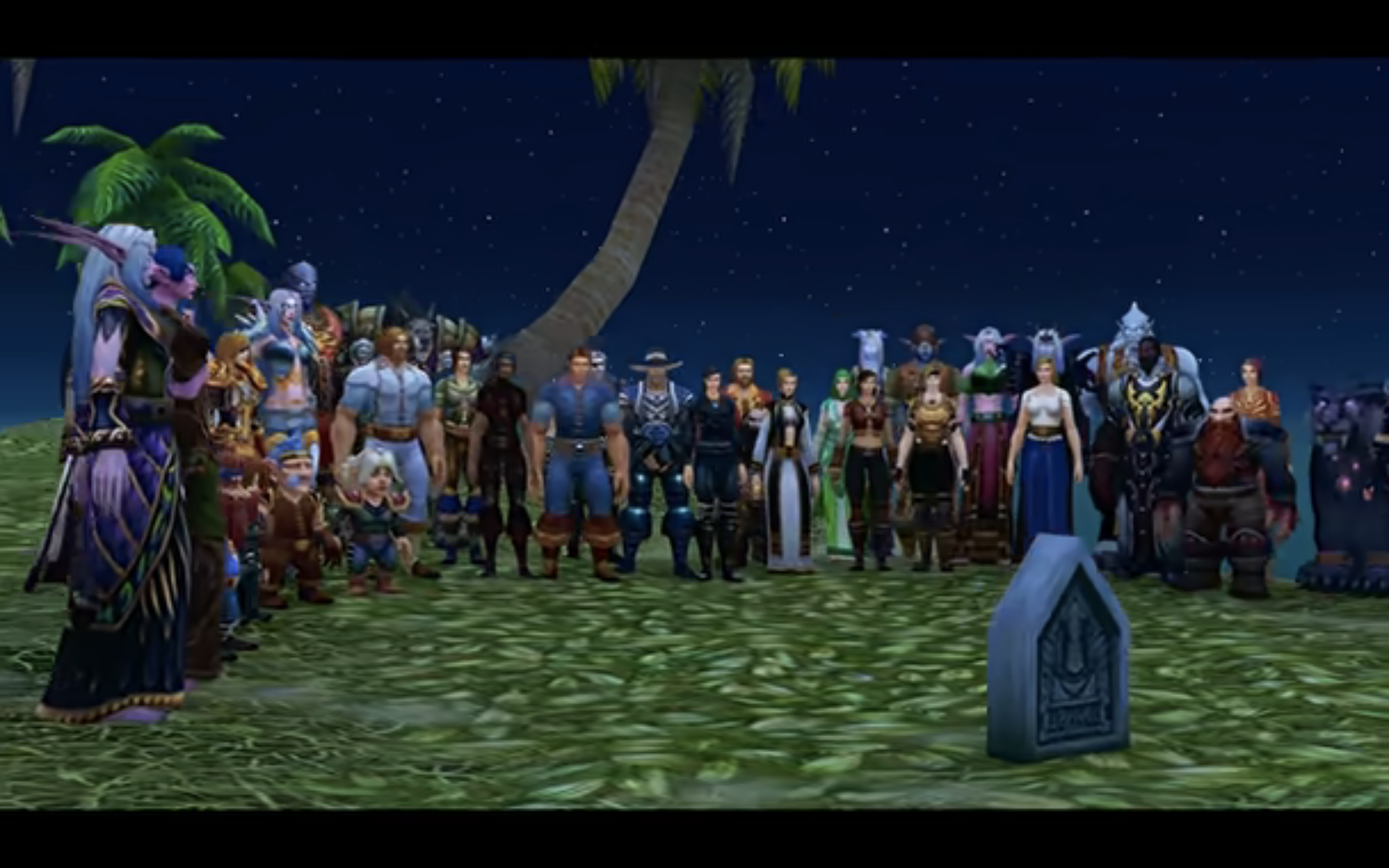
Ibelin concludes that what makes us human are the relationships we nurture, whether they exist in physical or virtual forms. The end of the film parallels the gathering of real people at Steen’s funeral with an animated gathering of the Starlight guild. The last shot reveals Steen’s gravestone inscribed with the epitaph, “Mats ‘Ibelin’ Steen…deeply missed, never forgotten.” For Steen, WoW was a place that freed him to live a full social life with real people. The film ultimately argues that the relationships we develop in our virtual lives are not disposable. In fact, they may be the ones that define who we are. Like our virtual experiences, the hybrid form of Ibelin may be a part of a trend in documentaries where the accuracy of visual representations of people and events matter less than recreating the technology-enabled experiences that we are quickly redefining as real.
“Is it Cripping Documentary?”
Leshu Torchin (University of St. Andrews)
Benjamin Ree’s documentary The Remarkable Life of Ibelin (2024) juxtaposes two realms: the confined domestic space of Mats Steen, a Norwegian man with Duchenne muscular dystrophy who died at 25, and the expansive virtual landscape of World of Warcraft, where his avatar Ibelin Redmoore enjoyed robust social connection. This juxtaposition—and its subsequent fusing in the documentary—generates productive tensions for considering the relationships between animation, virtual reality, and disability representation.
In Animated Film and Disability: Cripping Spectatorship, Slava Greenberg argues that animated documentary fosters alternative spectatorial modes that subvert ableist paradigms, and similarly, I wonder if Ibelin has the capacity to “crip” documentary. The documentary’s title would initially suggest this is a lost cause as its focus on a “remarkable life” risks invoking what Stella Young termed “inspiration porn,” wherein disabled individuals’ achievements are framed as extraordinary solely due to disability. And yet, such a reading deserves reconsideration: the qualifier “remarkable” applies to Ibelin, Steen’s non-disabled avatar, and the social ecosystem he cultivated. What emerges as remarkable, then, is the vitality of the virtual and its entanglements with material reality.
These entanglements call to mind the “reversibility of touch,” Maurice Merleau-Ponty’s phenomenology of intersubjectivity that has the capacity to challenge binary oppositions. Merleau-Ponty uses an example of his right hand touching the left hand to communicate the shared experience of both touching and being touched. This reversibility blurs the boundary between subject and object, which harbors many implications. For Janet Price and Margrit Shildrick (and for Greenberg, through whom I encountered this productive combination), this reversibility of touch not only challenges oppositional binaries and hierarchies of power but highlights contingency and the ongoing processes of constitution and reconstitution. While I hesitate to analyze the film primarily through spectator embodiment, this concept invites us to consider how the documentary places different forms of representation – animated and live action, real and virtual – into relation, establishing reciprocity that destabilizes both documentary truth hierarchies and questions of worldly value. This concept illuminates Ibelin’s representation of virtual-physical intersections, providing a space where these ostensibly discrete realms interpenetrate and transform one another, disrupting normative hierarchies of “authentic” or “valuable” experience.
The entanglements between virtual and physical realms in Ibelin materialize through technologies simultaneously mediating and assistive. Through game technology and the assistive technologies that facilitated gameplay, Steen cultivated global friendships and intimate connections. These technologies generated spaces for authentic affective exchanges and interpersonal intimacy. Moreover, this capacity extends beyond Steen. Lisette, one of the guild members, recalls a conversation she had with Steen in-game when she disclosed the challenges she was experiencing with her touch-averse autistic son. How could she foster closeness with her child, who seemed closed off to her? The answer was to engage her son through his interests, including gaming—advice that culminated in an in-game embrace between mother and son. The virtual domain seems to “touch back,” reconfiguring physical relationships and generating new connective possibilities. Steen has meaningfully touched others, and in-game touch enhances the relationships that exist virtually and in the world.
These encounters also reconceptualize the idea of assistive technology beyond remedial interventions for bodies perceived as “deficient.” Although the film acknowledges how World of Warcraft helped Steen navigate physical limitations, it equally reveals how these technologies provide assistance across different embodiments: Lisette, the non-disabled parent, benefits significantly, and beyond that, Rees shows the numerous guild members who are enriched by their online community. They have been touched by Steen/Ibelin and each other.
Reversibility of touch manifests in the animated sequences—both in themselves and in relation to the photographic mediation of home video, interviews, and observational sequences. To produce the animation, director Rees and Machinima animator Rasmus Tukia drew on approximately 42,000 pages that logged in-game chats, roleplay descriptions, achievements, system messages, item databases and more to recreate the world Steen inhabited as Ibelin. These digital artifacts, supplemented by in-game research, interviews with players, and interpretive work, serve as documentary evidence while simultaneously providing the architectural framework for reanimating virtual encounters. Although Tukia opted for a more recent version of World of Warcraft to animate these scenes (rather than the version Steen would have used), these nonetheless have a stronger, if still virtual, basis in that past reality, preserved thanks to an “addon” that functions to save the game or restore it in the event of disconnection. It is reenactment and replication of a referent that remains available.
This production method invokes assistive technologies of access—this time to a past life of a person not able to participate in the making of the film. However, this approach raises questions about which forms bear the greatest “indexical” link between referent and representation. The film constructs a pronounced visual contrast between representations of Steen in physical space and his virtual existence as Ibelin. The videos of Steen taken by family not only center on his confinement, presenting a reality that was not fully in keeping with the world he kept hidden, but they bear the marks of video degradation. However, these documentary images with a presumed direct correlation to reality are shown to be limited in content and appearance, only capable of rendering some of the story, particularly when compared to the vibrant world of World of Warcraft—rich in color and in human connection. In these sequences, recollection is more than memory work; it is the literal collection of data used to reanimate the past. Annabelle Honess Roe has already argued for animated documentary’s privileged access to subjectivity; this capacity is enhanced here through game logging technologies, generating a documentary form that further challenges those hierarchies of representation. Moreover, the highlighting of the real could possibly aid in challenging a narrative opposition that depicts Steen as “escaping” his reality rather than enjoying a second one.
The documentary’s concluding image presents its most potent challenge to material/immaterial and real/virtual binaries. Steen’s headstone, inscribed with his World of Warcraft avatar’s silhouette, materializes his virtual existence. This visual metonym literally inscribes the purportedly “immaterial” digital persona into the material: the gravestone. By etching the virtual onto the stone, by making it concrete, Steen’s family acknowledges his digital existence as Ibelin not as peripheral to his “authentic” life but as a co-constitutive part of his experience.
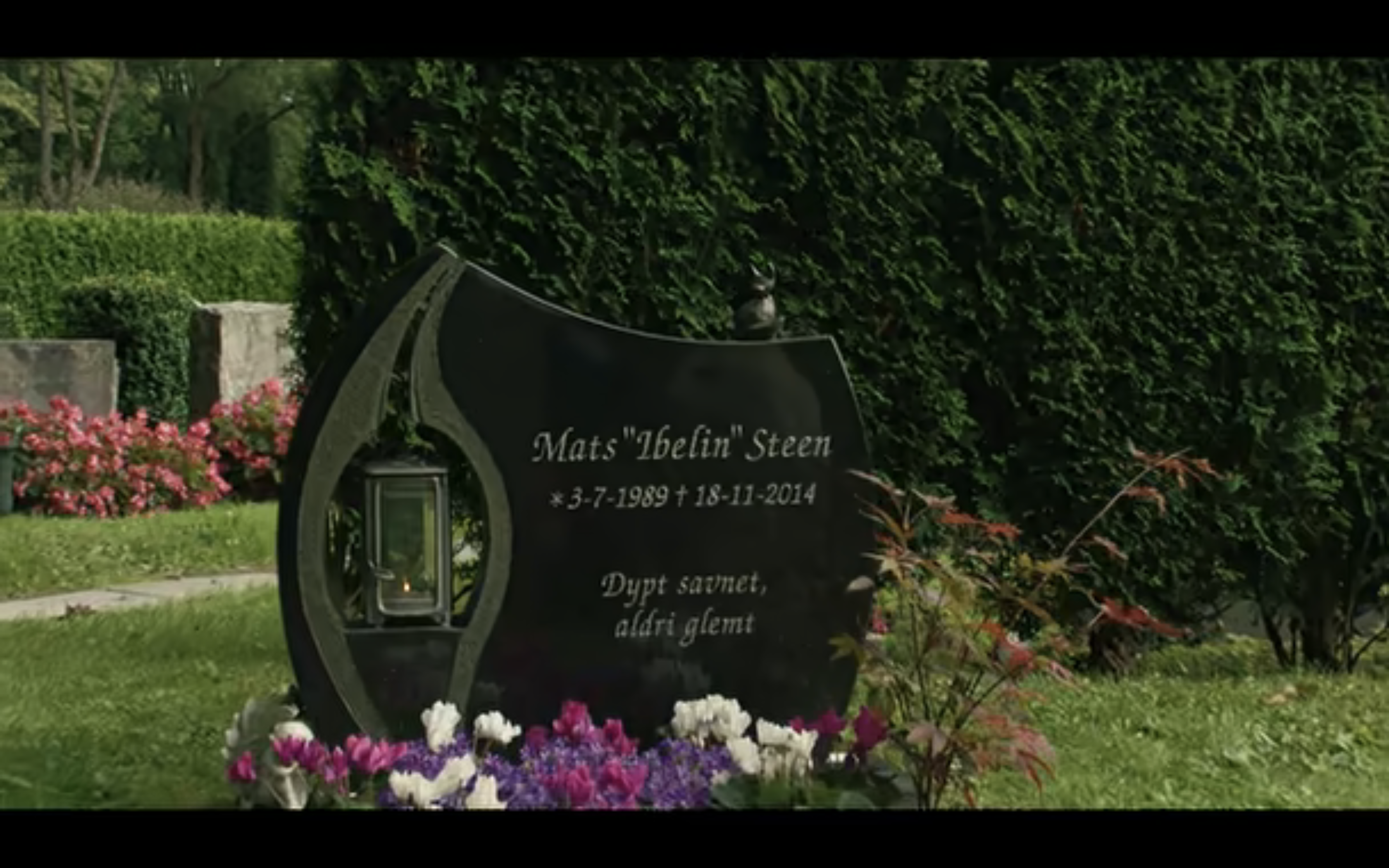
At the same time, this closing sequence does open up a question of privilege. This material expression of mutual value is through photographic indexicality that risks privileging it as the last word in what constitutes reality. There may have been some destabilization in the presentation of the life of Steen and Ibelin—destabilization that subverts presumptions of binary oppositions and hierarchies of authority—but this seems to be undermined by this last scene. Nevertheless, the film demonstrates potential for the coexistence of these worlds and multiple modalities of experience and perception. This transformation creates space for disability that is neither cordoned off nor necessarily marked less-than but is, rather, integrated into a world in which every body must acknowledge its own variable limitations.
 DOCALOGUE