

“Industrial Melanism and the Mass Filament”
Thomas Pringle (University of Southern California)
Originally published in 1935, Roger Caillois’ essay about the behaviors driving insects to camouflage with their surroundings, “Mimicry and Legendary Psychasthenia,” may be the most influential writing about moths in documentary criticism. A curious blend of entomology and social theory, Caillois fixed upon a problem posed by how moths—in their significantly proliferating speciation—evolve apparent protection in how they optically mimic the visual and textural qualities of their environment. Of moths, “chromatic mimicry” is “an actual photography, but of the form and the relief, a photography on the level of the object.” Moths are the ultimate convergence of a sequence of physical forms. They emerge from a series of instars and molts, while realizing through their bodies an aesthetic mimesis that is cumulative of historical adaptive efforts specific to each species. They are a three-dimensional relief, or a realized model, of both evolutionary history and their visual environmental field. Unexpectedly, Caillois writes that “predators are not at all fooled by homomorphy or homochromy,” as “resemblance is all in the eye of the beholder.” In a moth’s camouflage, as much as the insect articulates its environment and recapitulates its evolution, it does so in the direction of the perceptive capacities of observers, often performing successfully for humans and sometimes less so for other predators that do not share the anthropomorphic frame. Optics, documentary visuality, and anthropogenic environments together form one line of contemplation in Michael Gitlin’s The Night Visitors (2023), which expressly draws attention to moth specialization in environments structured by silk commodity markets, pervasive light pollution, and the documentary record. As an intertitle announces, “the camera makes close viewing possible, but it also invents a dramatic protagonist, which distorts our perception of the moth in its environment.” When seen through the eye of the camera, do moths resemble the anthropogenic environment as we see it, or something entirely inaccessible?

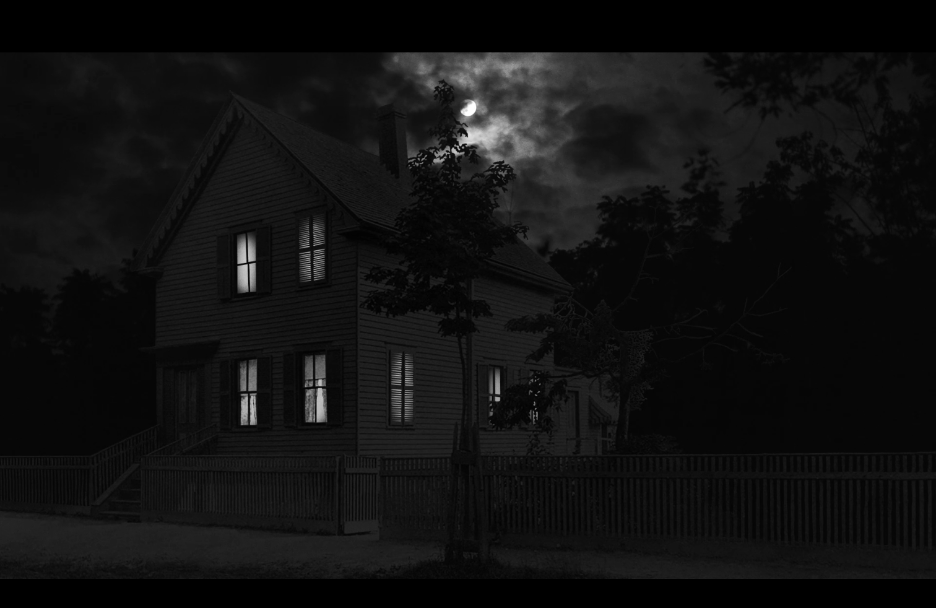
Gitlin’s film foregrounds moth behavior and developmental biology within a historical period when the built environment pervasively architects the insect’s visual field. While the experimental qualities of The Night Visitors’ soundtrack merit their own essay, I want to focus on the film’s meditation on light and evolutionary adaptation. Often filming in darkness, The Night Visitors exposes artificial light and moonlight comparably, emphasized through recurring formal decisions in the film. The opening shot frames the spatial depth of a suburban street through a sequence of activating light sources: cones of streetlight illuminate a path through the depth of the image, while the moon brightens a canopy of trees indicating background (figure 1). Areas of the frame without illumination are negative space, and what is and isn’t lit up marks how the documentary encourages viewers toward the equation of moonlight and anthropogenic lighting. These sequences are reminiscent of Deborah Stratman’s In Order Not To Be Here (2002), as the volumetric space of the image—a meandering road toward back of frame with a hint of canopy in the distance—is directional for the eye but also a space of possibility for potential movement, as darkness is more a physical barrier than open enticement. Comparable images appear throughout the film, such as a portrait of Étienne Léopold Trouvelot’s Massachusetts home, where the 19th century astronomer and amateur entomologist’s lit windows conjure the viewer’s imagination of insects flapping against brightened glass at night (figure 2). Backlit by the moon, the shot reinforces how, while the film does not try to simulate moth perception, it does formally imply how the insects conflate electricity with lunar radiance. “But with a moth,” another title reminds us, “the eyes we look into reflect back to us only something unknowable.” We could say the same about the camera lens.
Toward the film’s conclusion, Gitlin narrates how it’s not fully understood why moths are so attracted to artificial light, but the observation that moths are less drawn to it during the full moon implies perceptual confusion between sources. Another possibility is that the long evolutionary history of moths, guided by sight capacities tuned to the darkness of night, has been interrupted by the proliferation of human built light sources. Further afield is the theory that electric light might be a pheromone signal, a sensory simulation of sexual attraction. Moths crawling over Edison bulbs give way to the Mass Filament of Times Square, paired with spectacular historical reporting about the modern industrialized city’s action as a gravity well for light-drunk insects. Gitlin suggests a relationship between artificial light and declining insect populations, and the film points to the brightness of modernity with great ambivalence. Evolution, here, seems to take a cue from capitalist economics, as extinction is both creative and destructive, ending some species and further specializing others. Just ask Biston betularia, the peppered moth that adapted its coloration to soot-covered trees during the Industrial Revolution. There are over 70 moth species displaying so-called “industrial melanism,” and The Night Visitors has pushed me to imagine a transparent moth that might one day camouflage against brightly lit glass.
Then, there is a question about industrial capitalism and its environmental impacts under the surface of The Night Visitors, embodied by Trouvelot’s moth-breeding experiments intended to reinvigorate the U.S. silk industry, which declined due to market speculation in mulberry trees and the reconfiguration of cotton supply chains following the pronounced abolishment of slavery. Gitlin notes that Trouvelot’s effort to industrialize moth reproduction and silk generation through bio-speculation experiments—crossbreeding endemic and imported moth species—did not return silk nor profit from investment but, instead, socialized a more general ecological disruption. Joining escaped invasive moth species were introduced bio-control agents, which precipitated cascades of charismatic moth death, by “80 or 90 percent” in some areas, per Gitlin.
A series of images depicting the handling of Hyalophora cecropia cocoons for silk production shows how human labor unwinds what has already been built by a moth, creating materials for a commodity of strictly Homo sapien use. The film concludes with silk threaded through a needle, gesturing toward the biological base of fabrics. Trouvelot’s experiments with moth biology—and their cascading effects—exemplify how industrial society changes ecologies much more broadly, wherein the affordances of modernity—say, silk clothing or electrical light—not only depend on resources drawn from environments but also intervene within the processes by which environments reproduce. If a moth photographically embodies the history of industrialism, this documentary accordingly photographs a deepening relationship between industry and environment for the viewer. Karl Marx described the silkworm’s life, which spins a cocoon of economic value, as a metaphor for the subsumption of human labor under industrial capitalism, implying that human life might coincide with production so fully that alienation would itself become alienated. When moths live, go extinct, or physically adapt to industrial landscapes, they illustrate how human activity destroys and creates environments such that only imbrication is identifiable. It may be difficult to precisely say the degree to which the decisions of Trouvelot or Edison have contributed to North American moth decline, because many factors surely contribute. The Night Visitors directs us toward this uncertainty, how natural history and industrialism have developed intense and unknowable dependencies, some of which are beyond causal attribution. The ineluctably anthropomorphic frame of documentary shows us moths as they embody the world we both shape and perceive.
“Fleeting Lives”
Laura McMahon (University of Cambridge)
Denizens of the night, transient and mysterious, moths feature in the writings of Virginia Woolf, W. G. Sebald, and Vladimir Nabokov (who was also a well-known lepidopterist). And they flicker into view in Stan Brakhage’s experimental film Mothlight (1963), which dreams up – out of a collage of moth wings and foliage pressed between two strips of 16mm splicing tape – a visionary response to the fatal attraction of moths to candlelight, their tendency for self-immolation.
Michael Gitlin’s experimental documentary The Night Visitors (2023) shares in these fascinations. While structured in part around the different “instars” (or stages) in the life cycle of Hyalophora cecropia, a large silk moth, this is no conventional nature documentary: its take on the subject is experimental, offbeat, and often playful. In counterpoint with close-ups lingering over the quirky physical details of various moth species and footage of a group of enthusiasts gathered around a moth light at night, the film marshals a polyphonic array of voices. It quickly throws off any pretence at scientific formality, as we hear echoey voices offscreen: “That is a beautiful moth. Really, really incredible”; “Holy crap. Wow.” And later: “It’s kind of gross”; “That scared the bejesus out of me.” Taken together, these comments capture much of the film’s ambivalence toward its subject: moths are intriguing, beautiful, yet also utterly strange, alien, even disgusting and terrifying at times. Much of the film’s interest lies in mapping the rich scope of these different subjective perspectives. In contrast to a recent wave of documentaries about animal lives that have sought to stage, to differing degrees, a withdrawal of human presence (such as Emmanuel Gras’s 2011 A Cow’s Life and Victor Kossakovsky’s 2020 Gunda), The Night Visitors foregrounds human subjectivity, emotion, and entanglement across species lines.
Such entanglements can be felt through the film’s frequent recourse to narratorial fragments, in voice-over and capitalized intertitles. The intertitles, grounded in the director Gitlin’s perspective, are by turns intimate, confessional, and philosophical. The first intertitle announces: “I’M BECOMING OLD AND STRANGE AND I WORRY THAT MOTHS ARE PART OF MY RETREAT FROM PEOPLE.” A later intertitle reflects: “IN COMING TO KNOW THE FLEETING LIVES OF MOTHS, I WAS INTENT ON A SMALL MORTAL SHIVER, METALLIC SWEET AND PAINFUL AS THE TOUCH OF A BATTERY ON THE TONGUE.” Full of pathos, yet wryly knowing, such comments register a sensitivity to impermanence that seems amplified in the context of the “fleeting lives” of moths. Gitlin has revealed in an interview that the “visitors” to which the film’s title refers are not only moths but “thoughts of death and loss” that haunt his insomniac nights. The film was shot during the COVID-19 shutdown, and this contributed – no doubt conceptually as well as practically – to what Gitlin describes as its “inward turn.” In a sequence reflecting on the death of his mother and the moth-eaten suit that Gitlin finds himself wearing to her funeral, moth and mother are enigmatically linked. In the broad weave of relationality to which The Night Visitors sensitizes us, the moth is a “SYNANTHROPE,” a “NEIGHBOR.”
Yet the intertitles also bear witness to the moth as alien being: “I ARRIVED AT THIS RUINED PLACE, UNEASY AND FULL OF DISGUST.” The film’s close-up images are highly tactile – often disturbingly so – offering intimate engagement with furry, quivering bodies and wings. Some sequences in particular – such as the “ecdysis to third instar,” in which the cecropia larva sheds its skin and emerges bearing spike-covered tubercles – seem likely to elicit disgust. One intertitle asks: “WHAT FRAME CAN I USE TO HOLD THIS FEAR? THROUGH WHAT LENS CAN I STUDY IT AND NOT LOOK AWAY?” There is a profound recognition that to come into contact with moths and their secret worlds is to enter into uneasy realms of wonder, repulsion, intimacy, and anxiety, and to reckon with what Gitlin refers to, in describing the film, as the “incommensurability of the profoundly other.” While a sequence delving into “The Sphinx,” a short story by Edgar Allen Poe, sees the film grappling with a gothic image-repertoire of moths as death-bearing and sinister, an intertitle comments wryly on the tale’s “OVERWROUGHT SYMBOLISM.” By contrast, later footage of a cecropia caterpillar pupating locates – in a material rather than metaphorical realm – the unfathomable wonders of transformation.
But the film’s interests also reach beyond the aesthetic and the affective, as it unfolds material histories of human-moth entanglement, attending in particular to our extractive relationships with moths. It briefly includes an example of silk processing, which involves boiling cocoons (as well as the silkworms inside them, though this is not mentioned here). A sequence on the French amateur entomologist Étienne Léopold Trouvelot and his disastrous, financially motivated silk moth-breeding experiments in New England in the 1860s, presents us with a horror story of human hubris and error, which came close to wiping out the cecropia species in North America.
The violence of an extractive relation to life runs through all this, and The Night Visitors seems aware of its own complicity. Cinema has historically treated animal bodies as sites of “rendering,” in a bid to produce not silk, milk, or meat but spectacle. The Night Visitors contributes to this history: at times, the moths are shot against black or white backgrounds, displaced from their natural habitats, constructing a deeply aestheticizing mode of vision. Yet Gitlin’s film also seeks to interrupt this drive for extraction. It self-reflexively draws attention to its own acts of mediation (draining the color from images, making voices repeat and echo). In a form of mise-en-abyme, a screen digitally superimposed upon an image of woodlands relays contemporary footage of moth trapping and species identification. All of this self-consciously “denaturalizes” the nature documentary genre.
The Night Visitors gradually reveals that to attend to the lives of moths is to delve into broader histories of environmental degradation. Gitlin’s film includes an extract from Thomas Edison’s The Cecropia Moth (1916), before noting the irony that “the first movie of a moth comes from his film studio, given the effect that the Edison lightbulb had on the life of the nocturnal world.” Articles from The New York Times, dating from 1909 onwards, appear onscreen, their reports describing “plagues” of moths descending upon New York, drawn to the city lights. Gitlin’s voiceover speculates upon different reasons for this attraction to electric light, before revealing his favorite theory: that light is perceived by moths as a pheromone, who flock to it in a state of erotic intoxication. Yet, as Gitlin suggests, this “blinding” reconfiguration of their habitats must be “terribly disorienting.” The film asks to what extent electric light – and of course industrialization more broadly – has contributed to “the moth apocalypse” and “the larger crisis of crashing insect populations.” And so, the film leaves us with a final irony: that the electric light to which moths are ecstatically drawn is part of a broader system of ecological devastation that is killing them. There is something of a return here to Mothlight’s linking of illumination and death. Yet, while Brakhage was struck by what he described as “crazy moths” self-immolating in candlelight, Gitlin keeps the focus firmly on human folly. The Night Visitors is a rich, fascinating, often whimsical tribute to moths, in which their myriad entanglements with humans are never far away.
 DOCALOGUE