

“Toxic Land”
Hannah Goodwin (Mount Holyoke College)
Irene Lusztig’s Richland appears, at first, to be simply a close investigation of one town’s troubled relationship to a past of mining the plutonium that was an integral ingredient in the bombs dropped on Hiroshima and Nagasaki. We see parades celebrating this history as well as events commemorating the lives lost; we hear staunch defenses of the high school’s mushroom cloud mascot as well as voices articulating the need to change it; we hear rosy recollections of happy childhoods and see tears shed over family members who have died of radiation-induced cancer. But as the film unfolds, letting us sit with some of the townspeople as they slowly reveal perhaps a bit more than they meant to, we realize the film is much more than just an exploration of these tensions in one town: it is a quiet indictment of American patriotism and the stories we tell about what it means to be American.
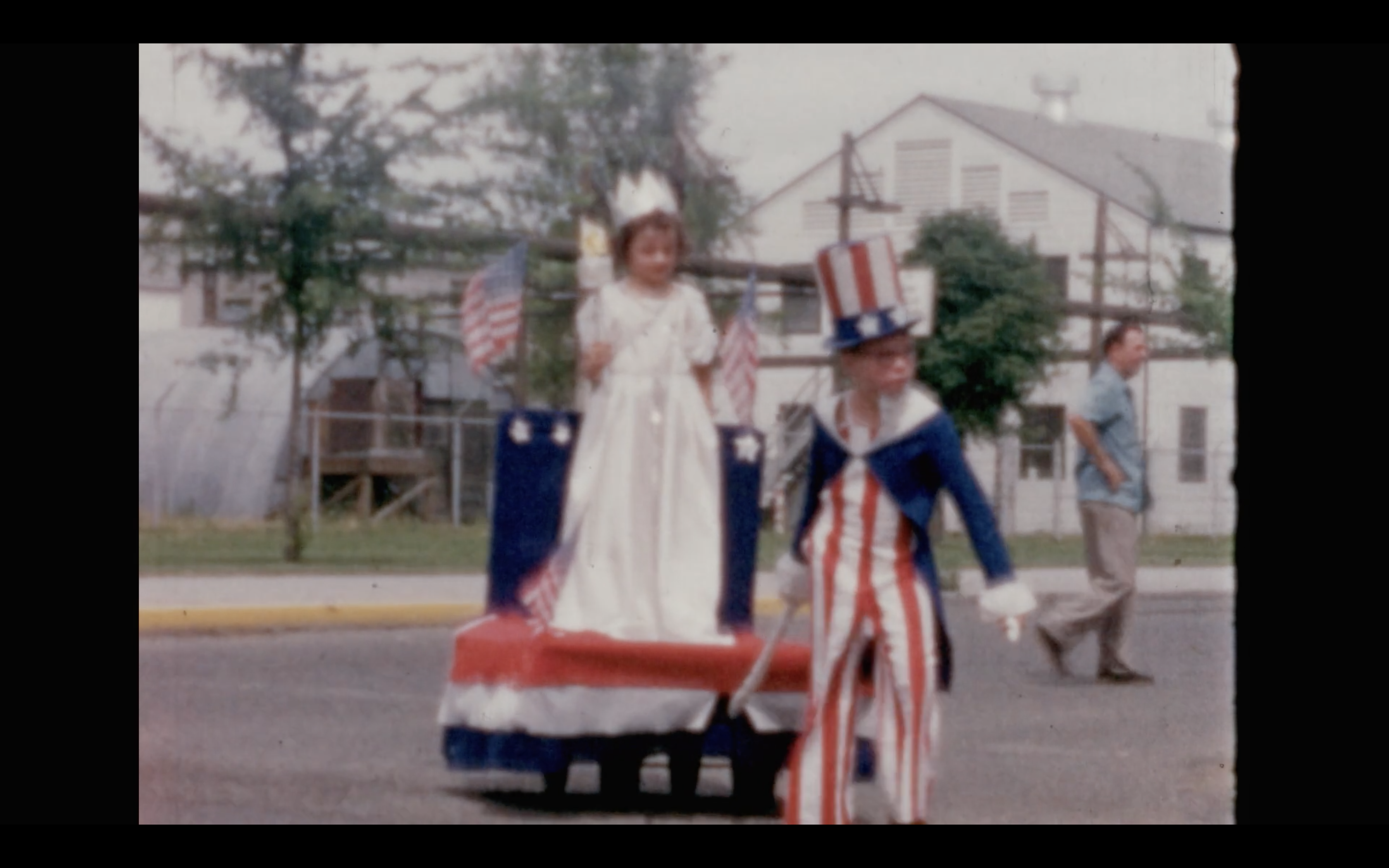
The film is built around a series of interviews with Richland residents, including several that are punctuated with the reading of a poem from Kathleen Flenniken’s collection Plume, which recollects her childhood in Richland and the damage done by radiation. This regular interjection of Flenniken’s voice lends the film a kind of symmetry in keeping with the architecture of a town built “almost overnight” in the 1940s for a new nuclear workforce. These interviews, which are almost all with white residents of Richland, foreground an impulse to preserve the American suburban fantasy of happy families and safe neighborhoods. This seems innocent enough when it comes to the local Alphabet Home Preservation Advocates, a group that, we hear, aims to restore in full historical fidelity the quintessentially suburban “alphabet homes” that housed the almost exclusively white workforce of the 1940s/50s uranium miners. Such preservationism is accompanied by a sense of nostalgic desire on the part of many interviewees to remember their upbringing as idyllic, their families as perfect microcosms of a thriving nation. They recall childhoods in which children played freely outside, fathers worked hard and provided for their families, and neighbors were always friendly to one another. But the film allows disquieting truths to taint these warmly remembered, sepia-toned images of mid-century harmony. A poem read aloud by one interviewee summons an image of children gleefully chasing after a truck as it spews clouds of insecticide, breathing in its sweet fumes. The poem’s reader, who remembers doing this himself, recounts how the children would drench their t-shirts with the insecticide so they could ball them up at night and inhale the scent in their sleep, too. This vision of invisible particles filling innocent young lungs evokes the larger question of toxicity that permeates the film and the environs it depicts. Throughout the film, we see a landscape that has been poisoned with radioactive material, and at various moments we hear about people who have died prematurely, the possibility of contaminated fish in the food supply, and land rendered useless for the human future.
Almost everyone in Richland seems cognizant of the town’s contamination at this level. Whether they eat the local fish, whether their own fathers suffered from cancer, and whether they are willing to criticize the industry that took this environmental toll, they know that the radioactive material in their soil, water, and wildlife is not a good thing. But the film goes further, using this physical contamination to echo an equally sinister but less openly acknowledged toxicity: the poison of an American patriotism that is tainted with insidiously casual racism and that turns a blind eye to the havoc postwar capitalist values have wrought on the environment and on people across the globe. In one scene, we follow a woman who grew up in Richland as she shows us around the neighborhood where she was raised, reminiscing about her “fun” and “sheltered” upbringing. When asked about the racial profile of her neighborhood, she comments that of 440 students in her high school class, only two were black. But she is quick to normalize this—it was not “any different from the 50s anywhere in the US,” and in contrast to a nearby town that was explicitly “closed,” she suggests that whiteness “was just the nature of things” in Richland. Lusztig does not outwardly challenge the woman’s understanding of how planned developments were made to be so white but lets us stew in the flicker of discomfort the woman evinces. Another interview is similarly telling: what begins as one resident explaining his push to change the school’s mascot from the mushroom cloud turns into a rambling soliloquy on Robert E. Lee’s decency and the banality of slavery. At another juncture, Lusztig makes explicit the racial unease of this town’s politics, as she films Japanese artist Yukiyo Kawana telling an all-white audience at an event celebrating reconciliation between Richland and Nagasaki that as the only person of color in the room she is “quite uncomfortable.” Notably eliding Japan’s own colonial, military, and nuclear legacies in pursuit of its critique of US policies and actions, the film includes Kawana’s admonishment that the town has not adequately acknowledged the indigenous tribes whose land has been wrested from them to serve the military actions of a nation they never consented to being a part of. This is one of several junctures at which the film reminds us that this land that has become a symbol of white nostalgia is the homeland of indigenous nations. These tribes’ continued presence on that land is evident in the film’s opening shots and in a frank interview with a local chief and his family, who express an ongoing responsibility to the land that contrasts with the way the nuclear production complex treated it as disposable.
As the narrative of innocent white suburbia gives way, Lusztig thus gestures to a wider critique of American exceptionalism and patriotism that are couched in innocent town pride and quaint, child-friendly rituals like the Atomic Frontier Day parade. Hope lies in the less dogmatically patriotic future evoked by a thoughtful conversation among a diverse group of high schoolers. One young woman, a daughter of immigrants, speaks of her love of America that is not without criticism and shame. As the students look to change what one young man refers to as Richland’s “romanticization of nuking people,” she asks: “Who’s ready to fight for what they believe in?”
“Things and Places Remembered”
Hannah Holtzman (Sophia University)
As the Bulletin of the Atomic Scientists moves the Doomsday Clock ever closer to nuclear midnight, filmmakers in recent years have returned to a subject that has riveted audiences since the first atomic explosions in 1945. The year of the nuclear blockbuster Oppenheimer also saw the release of Irene Lusztig’s Richland (2023), a quieter documentary that attends to spaces and people overlooked by Christopher Nolan’s film. If Oppenheimer is an expansive biopic critiqued for its emotional distance and exclusion of the many populations impacted by the development and use of nuclear weapons, Richland is an exploration of nuclear feelings, a film that acknowledges the humanity of its diverse interview subjects who have all been impacted in one way or another by the nuclear industry in Hanford, Washington.
In the opening shots of Richland, twigs sway in the shrub steppe land along the Columbia River in South Central Washington, a Department of Energy sign warns “No Trespassing,” and members of the Confederated Tribes of the Umatilla Indian Reservation work to restore the land around the Hanford Site where plutonium was produced for use in the first atomic bombs. In the next scene, the Richland High School football team – the Bombers – run on field to cheers from fans in camouflage shirts and caps. They hold a sign: “WELCOME TO BOMBER TERRITORY.”
The opening of Richland presents a simple opposition. However, the film will ultimately explore the meaning of the atomic bomb’s development and use through conversations with a variety of people in and around Richland, the town established in 1943 for Hanford Site employees and their families (notably, on land traditionally used by the Wanapum, Yakama Nation, Confederated Tribes of the Umatilla Indian Reservation, and the Nez Perce tribe). Richland offers both a broad and considered look at the impacts of the American nuclear industry in a key location of the Manhattan Project. The plutonium produced here was used in the bombs that the United States detonated in the Trinity Test in Alamogordo, New Mexico and over Nagasaki on August 9, 1945.
Nearly eight decades after the first atomic bomb explosions and countless films documenting and imagining nuclear disaster, filmmakers addressing the topic continue to confront problems of representation. Whose stories are told, how, and by whom? What visual strategies can be employed to convey the immensity of nuclear power and its many short- and long-term effects, from the hypervisibility of the explosion to the invisibility of radioactive contamination?The mushroom cloud—an icon of nuclear war so overused as to have lost much its evocative power—remains a painful symbol for many. In Richland, the cloud is a symbol of pride, notably displayed as the logo of the Richland High School “Bombers.” And yet, as Lusztig’s engagement with the town reveals, Richlanders also have a fraught relationship with the symbol. The issue of visual representation is most powerfully confronted toward the end of the film during a conversation with a group of Richland High School students who express dismay at the symbol and their school’s motto “Nuke ‘em till they glow.” One student concludes, “I don’t think there’s anything inherently good about a mushroom cloud.” Another is glad to live in a country where she feels free to discuss these kinds of issues. The mushroom cloud debate, which has attracted media attention for decades, seems to be a familiar one in Richland, where nuclear references dot the local landscape.
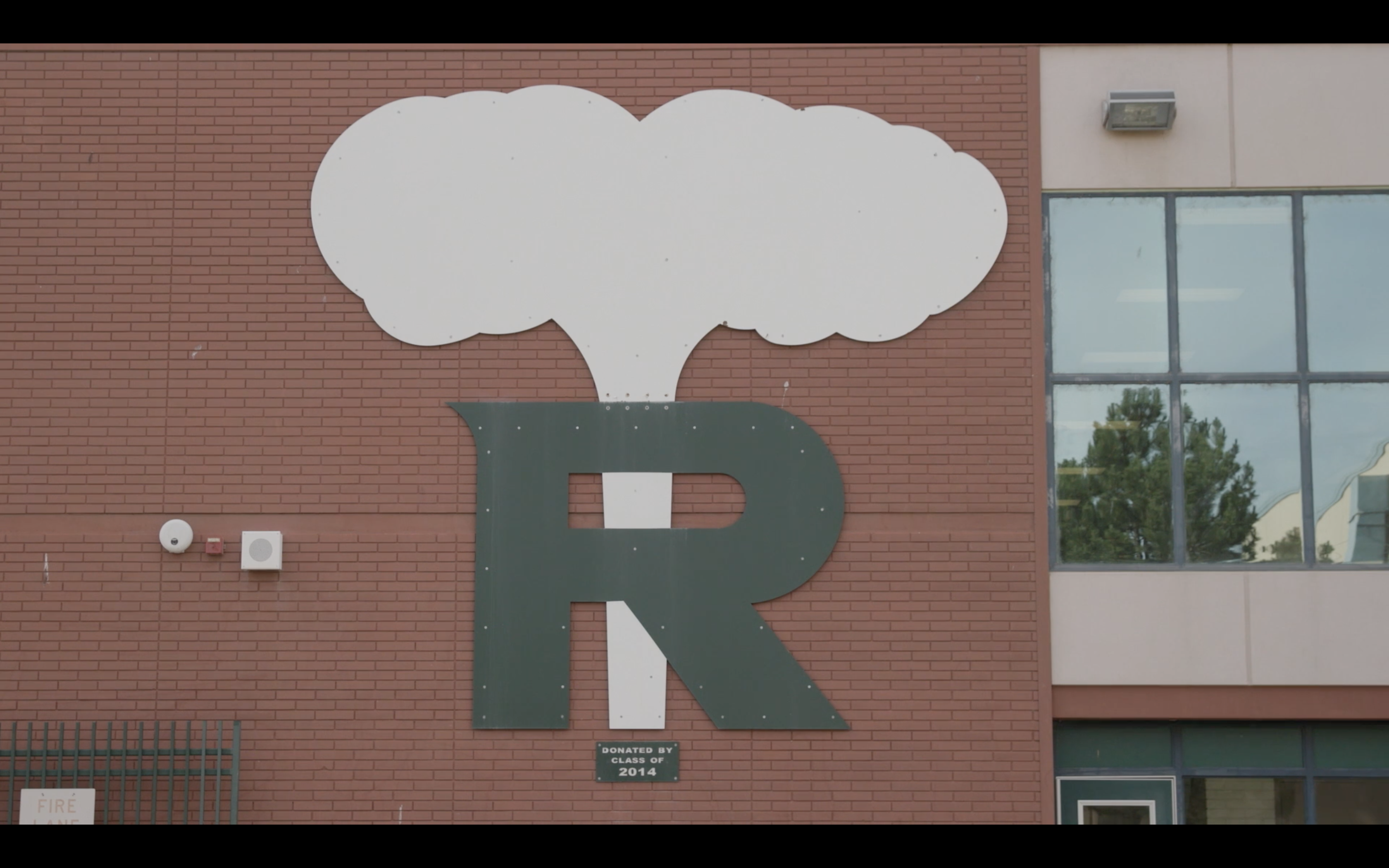
While Richland acknowledges the visual problem of the mushroom cloud, Lusztig also trains her gaze beyond it. In contrast to the excess and violence of this iconic image, Lusztig employs throughout much of the documentary an aesthetic of balance and control: long takes, fixed shots of still landscapes, interview subjects centered in the frame, symmetrical and balanced compositions. It is an attentive, often observational documentary that considers the feelings and memories of people in and around a town that only exists as such because of its role in plutonium production for atomic bombs. For some Richland residents, it was a “safe place to grow up” and a “sociological experiment that worked.” Others reveal greater ambivalence, such as an older couple admiring the beauty of the local river who admit that they don’t eat fish from it: “A lot of people do. … We swim in our swimming pool.”
In the final third of the film, the veneer of safety and control in Richland is worn away in a series of compelling scenes that focus on the people most negatively impacted by the nuclear history of this town. At the REACH Museum, which tells the story of the Manhattan Project, a tour guide recalls that a group of children visiting from Hiroshima “didn’t get the answers they wanted.” A Hiroshima-born artist tells a group gathered at the Richland Community Center for a commemorative event that they are not ready for reconciliation because they have not properly acknowledged the impact of what they are commemorating. The Wanapum chief and his family tell of their tribe’s care for and dispossession of the land that has become the Hanford Site. The students gather outside their high school to discuss its symbols and ask, “Who’s ready to tell an adult they’re wrong?” A final scene proposes a new image that evokes the embodied humanity of those most directly impacted by the atomic bomb.
Richland is a complex documentary by a filmmaker who listens deeply to her subjects. Lusztig stiches together their stories into a tapestry of a town that displaced indigenous communities and played a central role in the development of the atomic bomb. While exploring this past, she also reveals a present strained by political polarization. And yet, in the year leading up to the 2020 election in the United States, Lusztig looks beyond the loaded symbols—the American flags, MAGA gear, mushroom clouds, and bombers—and teases out the complexities of the individual perspectives of the people in and around the town now called Richland. What begins as a simple opposition of victims and perpetrators becomes an exemplary act of listening and looking beyond the spectacle.
 DOCALOGUE