

” Documentary and/as Surveillance”
Sasha Crawford-Holland (University of Chicago)
Brightly clad picnickers look up through cameras, cellphones, and cardboard glasses to view a solar eclipse in surreal imagery scattered throughout Theo Anthony’s documentary All Light, Everywhere (2021). These images distill several contradictions: they make a spectacle of spectators gathered to behold an avisual absence and the darkness that attends it through optical devices that sustain their vision by restricting it. Such paradoxes animate the entirety of Anthony’s film as it negotiates—and complicates—oppositions between light and darkness, visibility and invisibility, surveillance and sousveillance. Anthony situates documentary at the vanishing point of this latter dualism. Lingering comfortably in zones of indeterminacy, he invites us to grapple with documentary’s uneasy posture straddling repressive and reparative regimes of visuality.
All Light, Everywhere assembles a wide range of materials to explore the entwinements of visuality and violence, emphasizing the fallibility of human and machine vision, the fallacies of mechanical objectivity, and the weaponization of optical media. Anthony mobilizes strategies associated with the essay film—performance, citation, compilation, irony, reflexivity—to produce a hybrid text that resists encapsulation. Though it addresses everything from reconnaissance pigeons to artificial intelligence, the film’s most sustained critical trajectory concerns the development and marketing of body-worn cameras as devices that promise accountability but in practice only expand police’s discretionary power.
Anthony excavates both the political interests served by body cameras’ design and the imaginaries that fuel their development. In one memorable sequence, a spokesperson for bodycam manufacturer Axon (formerly Taser) escorts the documentary’s crew on a theatrical tour of the company’s headquarters, replete with cringeworthy moments of direct address (“come on in!”) and an impressive commitment to corporate gibberish. In a matter of seconds, the rep shifts from lauding the open-concept office’s ethos of transparency to highlighting the literal blackbox that houses the firm’s R&D division, apparently oblivious to the contradiction.
This staging of corporate performance as self-parody recalls the tactics that Harun Farocki developed to trace entanglements between capitalism, militarism, and media by treating trainings and advertisements as simulacral distillations of institutions’ ideologies. All Light, Everywhere investigates how technologies including body cameras, satellites, drones, and machine vision algorithms are transforming the ways in which institutions exercise power through the visual field. Like Farocki, Anthony dismantles myths of disinterested observation by situating these practices in genealogies that trace the consolidation of modern power through optical media. Interludes across the film meditate on Jules Janssen’s photographic revolver, Étienne-Jules Marey’s chronophotographic gun, Alphonse Bertillon’s criminological anthropometry, and Francis Galton’s composite portraiture.
This barrage of references is certainly familiar—perhaps even trite—to scholars of visual culture. Often, those rehearsing this genealogy evoke it to buttress totalizing claims that denigrate visual technologies – and even vision itself – as vehicles of domination. While Anthony certainly deploys this critical trope, far more compelling are the ways in which he activates the characteristic indeterminacy of the essay film to demonstrate how visual technologies might be mobilized to alternate ends. After all, to produce a film that critiques optical media’s repressive uses is to suggest that such technologies can also work against them.
This ambivalence is most pronounced across a second key throughline traversing the film. We observe a surveillance company’s belated effort to secure citizens’ consent to aerial monitoring above their community—after the firm had already deployed its cameras covertly on behalf of Baltimore police during the protests that followed their murder of Freddie Gray. In a sequence that resonates as the intellectual core of the film, the Black participants in a community relations meeting with the company’s white CEO offer penetrating comments informed by lifetimes of subjection to surveillance. A Haitian immigrant asks, pointedly: “How does constant surveillance help the community?” Others debunk the premise of deterring those in desperate circumstances: “They’re trying to survive! These kids don’t care about no camera.” Yet other attendees feeling abandoned by the state are willing to hear any proposal that might help to improve conditions in their neighborhood, yielding a complex, polyphonic account of how under-resourced communities negotiate issues of public safety.
Anthony draws reflexive attention to his mediating presence in countless ways throughout the film. Yet in this sequence, it is the film’s subjects who reflect a critical gaze back onto his cameras. “Why isn’t the cameraman Black?,” one asks. “You cannot come in the community and film people,” another insists. For some participants in the meeting, the difference between police cameras and the documentary crew are negligible. We are forced to ask whether distinctions between surveillance and sousveillance are really so clear-cut.
Previous sequences had developed resolute cinematic arguments dismantling the false promises of body cameras, framing them as devices that tend to expand rather than serve as checks on police power. During a similarly observational sequence in which Baltimore Police are being trained to use bodycams, Anthony’s quietly oppositional stance as a civilian infiltrator watching the watchers lends political clarity to this task. By contrast, in sequences documenting the community relations meeting, Anthony’s positionality and the role of documentary media become more ambiguous, even contradictory. The calculus changes when Anthony shifts his attention from the watchers to the watched, and All Light, Everywhere becomes not only a critique of surveillance but also, potentially, an instrument of it.
Rather than omit or reject the implication, Anthony embraces its challenge (and contribution) to his project. In some cases, he blurs subjects’ faces while audibly retaining their criticisms. When a disagreement arises between interlocutors, he pans to a woman closing her eyes and shaking her head before cutting away as the fading audio track registers escalating conflict. Whereas I saw this moment as staging the dilemma of documentary surveillance—briefly acknowledging the range of community viewpoints but refusing to linger on them as an outsider, some of my students nonetheless felt that it risked exploiting their plight for spectacle. My students aren’t wrong. However, it is this scene’s very inclusion in the film that enabled our differing interpretations by foregrounding documentary’s potential complicity in the logics and mechanics of surveillance. Rather than pursue vindication or resolution, Anthony stages the indeterminate vicissitudes of visual power relations and invites us to sit, think, and look among them.
“Criminal Composition”
Alex Hack (University of Southern California)
All Light, Everywhere, written, directed, and edited by Theo Anthony, slips back and forth in time, as he investigates the camera and its utilization in the creation and maintenance of highly specific punitive perspectives. In doing so, Anthony illustrates how, through the design and deployment of visual surveillance technologies, criminal becomes immovable type.
The film examines Alphonse Bertillon’s late nineteenth-century criminal portraiture and ‘scientific’ classification system, a.k.a. the original mug shot, and the efforts of eugenicist Sir Francis Galton to make these images predictive via their similarity. In tracing a history in which the very framing of the criminal—the ‘objective’ proof of criminals’ existence and their potential for future crime—helps justify law enforcement, Anthony lays a particular foundation. When pulled into the present, we are asked to reckon with the ways this strategy has been corporatized and further naturalized.
Much of the film’s throughline relates to the monetization of penal points of view and features Axon, a corporate giant in surveillance and weapons manufacturing. We follow its affable spokesperson, Steve Tuttle, as he lays out the features of the company’s various products, from body cameras to tasers, and eventually drones and police cars. The film elucidates a clear tension between the objectivity the company claims—its database is simply titled evidence.com, a promotional video flashes “capture clearer truth” across the screen—and the ways in which police perspectives are purposefully embedded into their products. This contradiction is built into their design. As Tuttle expounds on the features of the Axon Body 2, the company’s newest bodycam, he says:
Humans can’t see in the dark. So, if we had an incident in which someone maybe drew what looked like a firearm down a hallway, we don’t want the infrared to show that it wasn’t a gun or it was a gun because the officer doesn’t see in infrared, that could jade a jury. We want it to mimic what the human eye can see. If you go beyond that, now you’re going to see things that maybe a jury would say, “well the video saw that this was a squirt gun and not a real gun,” but the officer can’t see that, you wanna see what he saw. So, we saw some camera companies in the very early stages that were competing with us using infrared, big mistake, […] you can’t go into court like that, because it doesn’t mimic the human eye.
When the person behind the camera asks, “So there’s certain things you don’t want to see?” Tuttle evasively responds, “There are things you wanna see just like the officer sees, from the officer’s perspective. When it comes to court cases, what the officer’s perspective is key [sic], and that’s always been the case, so you don’t want to give them something beyond their perspective.”
Yet, as the film demonstrates, the relation between human eye and camera eye is not so straightforward. As we watch footage recorded by the Axon 2, the notion that it mimics the human eye becomes absurd, as its jerky, confusingly grainy picture muddles color, contrast, and edge. Often peering from beneath the drawn arms of an officer or shaken with their every step, it miserably fails to mirror human vision. Instead, it isn’t simply the wearer’s eyesight that the bodycam looks to reproduce, but their bias; as Tuttle says: “perspective is key.” The example of the gun drawn down a dark hallway is meant to reference the officer’s point of view and their correspondingly ‘understandable’ fear—reifying the existence of the dangerous criminal and justifying the officer’s actions.
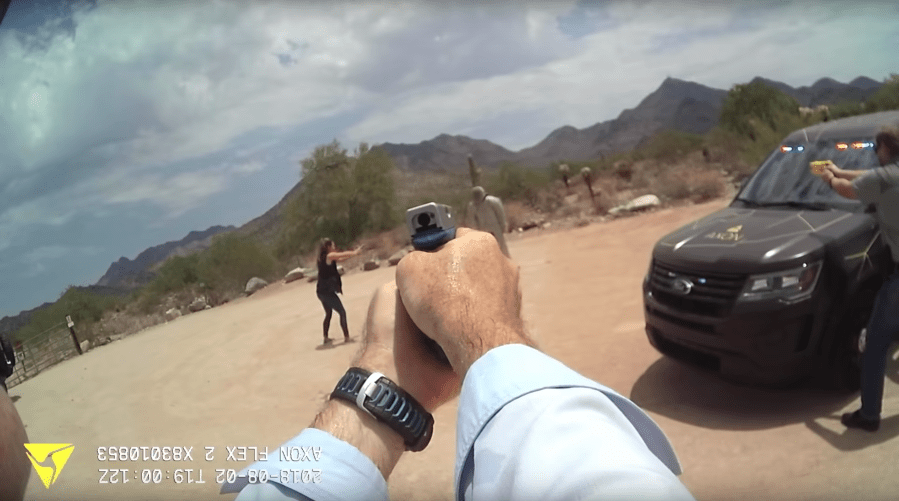
All Light, Everywhere also takes us to Baltimore, Maryland, where the Baltimore Police Department is being trained to use the Axon 2, and where Ross McNutt of Persistent Surveillance Systems (PSS) attempts to convince the community to sign off on his aerial surveillance program to help deter and prosecute crime in the city—a city that McNutt frames as “troubled” and ultimately criminal. McNutt, like Tuttle, refers to his spy planes as providing an “unbiased witness,” despite their presence in the city being a direct response to the unrest that followed the murder of Freddie Gray by police. In McNutt’s conversation with Black community members, it becomes clear that his allegiance lies with the same racist, criminalizing, and often murderous “system” that took Gray’s life. He says, referring to his surveillance of the community and partnership with police, “if you have justice, because the system works, I think the crime will come down significantly.”
As stated by the film’s narrator, the eye of McNutt’s aerial view “is made to look for crime in historically high crime areas, and so it will see crime in historically high crime areas”—as if a product of Galton’s dreams, crime and its alleged racial correlates become predictive and make this technology ‘necessary.’ However, despite this programmatic bias, these technologies and their viewpoints are deemed objective by the corporations that produce them, the law enforcement agencies that use them, and the judicial system that relies on the evidence they manufacture. This insistence on justice and objectivity is a way to obscure the carceral and racist nature of these technologies, but in showcasing what their specificity forecloses on, Anthony shines a light on the contours of this overproduced orientation.
What is prohibited in the maintenance of the ‘neutral’ perspective of law enforcement is telling. Infrared, with its garish spectrum of primary and secondary colors or its sharply contrasting grayscale, is said to disrupt the mythologized standpoint of the Axon Body 2 and its user—skin color additionally fumbled under infrared’s alien gaze. Further, the corporate response to the crucial issue of who gets to look at whom demonstrates that “neutrality” is not only technological but structural and political. After McNutt’s community liaison insists on a lack of alternatives to the aerial police surveillance of the community, alternatives are contrarily made clear—and rejected. “Are you saying the community will be able to use this?” someone asks and is told, “Well, no […] we still have lots of privacy policies.” Eventually, a local pastor insists, “Your perspective is different from mine. […] If you want to sell this program [to the community], turn the camera around.”
In revealing the many ways these technologies prevent other perspectives and utilizations, All Light, Everywhere reminds its viewer of strategies and frames of mind less invested in maintaining the ‘objectivity’ of carceral and racial capitalism—where everything from bodycams to doorbell cameras presuppose the threat of the criminal.
 DOCALOGUE