

“Cinema Forms Memories”
Anastasia Kostina (Yale University)
On March 10, 2024, Ukraine received its first Oscar in history for the documentary film 20 Days in Mariupol, the story of the siege of this Eastern Ukrainian city by Russian armed forces in February and March 2022. Coming on stage to accept the award, the director of the film, Mstislav Chernov, famously professed that he wished he never had to make this film, that he wished he could exchange the award for Russia never attacking Ukraine, but while he cannot change history, he can make sure that he is setting the historical record straight. “Cinema forms memories, and memories form history,” Chernov concluded before leaving the stage. Native of Kharkiv, Ukraine, Chernov was a reporter for the Associated Press when the war broke out on the day of the Russian invasion of Ukraine on February 24, 2022. He went to Mariupol to document the attack and soon found himself in a besieged city. Together with his crew, he arduously filmed the first twenty days of the 86-day siege which left Mariupol completely devastated (Figure 1).
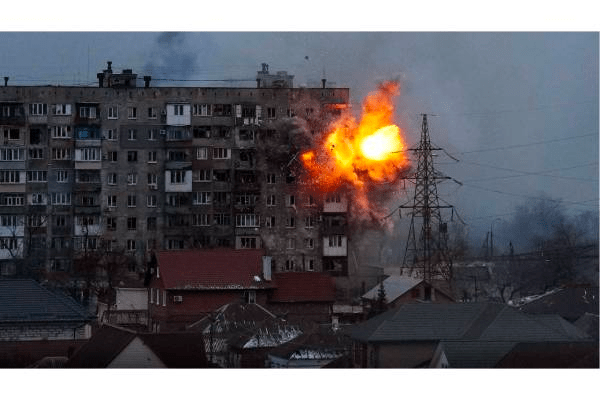
Primarily focusing on the deeply traumatic experience of the civilian population, Chernov tells the story of the siege through a combination of verité-style footage shot on the ground in Mariupol, aerial views of the destroyed city, and montages of news reports from Western media outlets using the footage shot by Chernov’s team. During the film, he frequently interacts with his subjects from behind the camera, but it is his rather detached voice-over narration that guides the viewer throughout the documentary, explaining the images and filling in the geopolitical context and other details required to better understand the narrative of the film.
20 Days in Mariupol is first and foremost a documentary of witness. Together with Chernov, we become witnesses to the atrocities and war crimes of the Russian invasion and the suffering inflicted on the people of Mariupol: from the panic of the first days to the destroyed residential buildings, looting, and families practically living in the DIY bomb shelters organized in local shopping malls. And the casualties, so many civilian casualties. The most unbearable sequences of the film take place at Mariupol hospitals where, despite the shortages of water, energy, heat and painkillers, medical personnel tirelessly work to help the wounded. This is where the film moves into the realm of the unwatchable. A four-year-old girl dying on the surgical table; a sixteen-year-old boy who lost both legs in Russian shelling dies before our eyes; a young couple bringing to the hospital their bleeding 18-month-old son to witness his death; a critically injured pregnant woman wounded during the attack on the maternity ward — the list goes on (Figure 2). These shots are overwhelming, unthinkable, unbearable. And yet, we watch – and witness – together with the entire world, as leading media outlets broadcast Chernov’s footage over and over in their news programs.
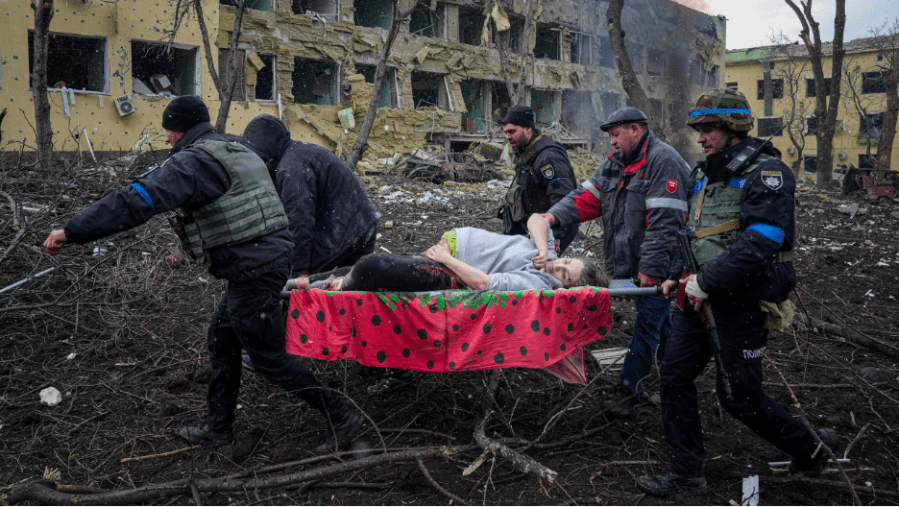
20 Days in Mariupol is also an advocacy film. The primary goal of Chernov and his crew was to secure as much footage of the gruesome consequences of the war as possible and to send it to the Associated Press so these images could be seen by millions throughout the world. During the film, Chernov repeatedly informs the viewer through his voice-overs that he was able to share a new batch of images with his editors or expresses his frustrations with the lack of cell signal and inability to send the footage. The visual storytelling also emphasizes the motif of “getting the story out there” by juxtaposing longer documentary sequences shot by Chernov on the ground with the same shots used in news reports all over the world. Strangely, but not surprisingly, the same images chopped into short fragments and embellished with TV-channel logos, tickers, and other broadcast graphics do not produce the same crushing effect as Chernov’s raw documentary footage. Some participants in the film also sincerely believe that circulating these devastating images will be enough to mobilize the West to help Ukraine. One of them is Officer Vladimir (who later helps Chernov’s crew to escape from Mariupol with all their footage), who requests to make a public statement on camera and addresses Western audiences in English: “Russian troops commit war crimes. Our families, our women, our children need help. Our people need help from international society. Please, help Mariupol.”
It is precisely the advocacy angle of 20 Days in Mariupol that justifies the intrusive nature of Chernov’s filming. He not only closely watches people during deeply traumatic experiences but also often asks them to identify themselves for the camera during these moments. We recognize that the camera does not prey on pain, grief, destruction, and devastation, because it is collecting important evidence to mobilize the public and to create a historical record. However, as Leshu Torchin points out in her article “Not Seeing Is Believing: The Unwatchable in Advocacy”, a question that always arises with advocacy films on sensitive subjects is whether one can, or should, make visible everything that has happened. For Chernov and his crew, the answer is an unequivocal “yes”! The camera lingers on the extremely graphic images for as long as it possibly can to amplify the pain and suffering. Chernov clearly articulates his stance as he addresses viewers from behind the camera following one of the film’s most heartbreaking scenes: “This is painful to watch, but it must be painful to watch!” For him, these painful, unwatchable and deeply penetrating images will form memories that will form history.
“What 20 Days in Mariupol Documents”
Anne Eakin Moss (University of Chicago)
What 20 Days in Mariupol documents is not only the devastating impact of Russia’s full-scale invasion of Ukraine in its first days on shocked and unprepared civilians in an important port city. Nor is it only the grimly heroic efforts of AP journalists to report all the horrors they witnessed from a besieged city. What it documents beyond all this is the extent to which disinformation has come to sever seeing from believing in the 21st century, and what documentary film can still do to repair that relationship.
Director Mstyslav Chernov is an AP video journalist whose reports out of Mariupol were, in those first twenty days of the siege, the only information coming out of the quickly encircled city. His team’s footage, together with photographs by Evgeniy Maloletka and reportage by Vasilisa Stepanenko, broadcast by news outlets around the world, were almost immediately accused of falsification in a wide-ranging Russian disinformation campaign.
The film counters these lies by scrupulously laying out what it took for the journalists to capture the horrifying images of dying children, indiscriminate bombing, mass graves, and devastated hospitals in Mariupol. With communications disrupted throughout the city, they risked exposing themselves to shelling or attack by climbing to the upper floors of buildings and traveling the streets to find enough cell phone reception to send out their dispatches in short bursts. While someone already inclined to believe Kremlin disinformation might be able to imagine that a 10-second clip on the nightly news was staged, this film takes it as its mission to dispel any possibility of disbelief. Ordering their footage day by day and including the unedited outtakes from a camera aimed at the ground as they run for cover, the spontaneous reactions of residents to their situation and the incomprehensibility of the bombing and tanks in their streets, the real time chaos of the emergency ward and the moments of nervous waiting, they oppose such accusations with the sheer duration of the lived experience of the siege. The sobs of the parents who lose their children in front of our eyes and the outrage and anguish of the doctors and nurses who tried to save them burn away any doubts that any reasonable human being could have.
“Show this Putin bastard the eyes of this child and all these doctors who are crying.
Show it. It’s good that there’s press here. Keep filming,” says a doctor, after ceasing life-saving efforts on the body of a 4-year-old girl. We too are forced to look, as we are sutured to the viewpoint of Chernov’s camera. The filmmaker’s own spontaneous reaction – read through the body language captured by the camera harnessed to his chest – becomes ours. Thankfully, he drops the camera, and we can bow our heads.
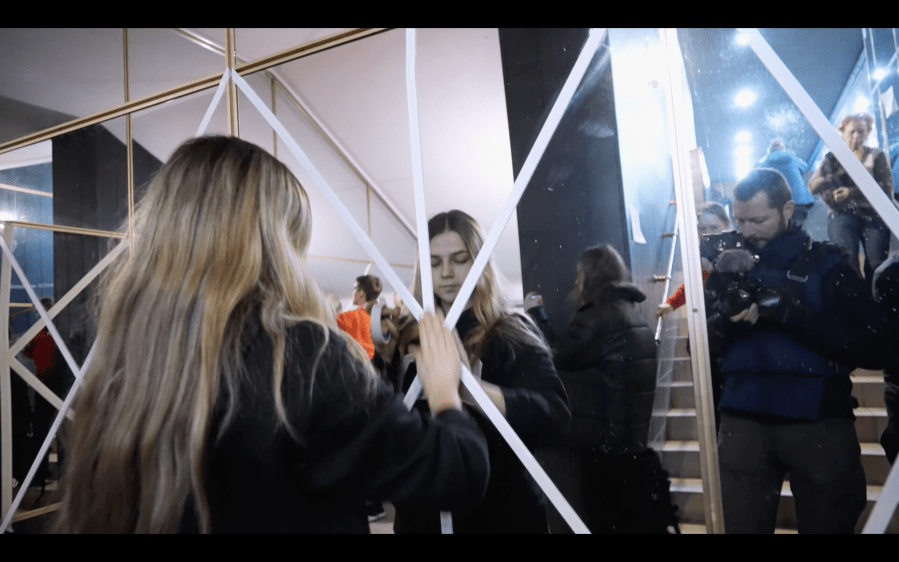
The film’s producer and editor Michelle Mizner has worked on numerous interactive documentaries: journalistic features that require the viewer/reader’s input to progress along the storyline and that offer choices as to which branches of the story to follow and how much detail to pursue. The Last Generation (2018, with Katie Worth), for example, documents the stories of three children living in the Marshall Islands and their experience of the increasingly destructive weather caused by climate change by inviting the user to explore as deeply into their stories as they like in a nonlinear fashion.
20 Days in Mariupol similarly uses all the affordances of documentary cinema to engage the viewer actively, to prevent disengagement. While the days of the siege flow forward unbearably in the film, they are punctuated by fragments of international news broadcasts that use Chernov’s footage to show the world the atrocities that were simultaneously being denied in Russia. Audience members of the film in the US and Western Europe will recognize that their understanding of Russia’s invasion in its first days was made possible by Chernov’s crew. Like hyperlinks to those short clips on the news, the documentary’s expanded coverage allows the viewer to mentally authenticate and personalize each report that came out of the besieged city. And, in turn, the impact this reporting had on international support for Ukraine serves to justify the sheer amount of human suffering Chernov, his team, and we, the audience, are asked to endure.
Of course, nothing justifies the suffering itself, and the film manages to avoid any sense of exploitation or instrumentalization of each individual death we are asked to witness. It is as if the journalists managed to escape the siege with the event’s black box. It has now been more than two years since Russia’s full-scale invasion of Ukraine. Mariupol is still occupied by Russian-controlled forces. The recent Academy Award for Best Documentary Feature received by the film will unfortunately do little to convince avowed supporters of Putin that its version of the siege of Mariupol is more real than what Russian state-controlled media tells them.
But viewers who wish to follow the documentary traces of what happened in Mariupol beyond and after Chernov’s reporting can take a look at Beneath the Rubble: Documenting Devastation and Loss in Mariupol, an interactive web feature produced by Human Rights Watch, SITU Research, and Truth Hounds. It uses video, photography, satellite imagery, and interviews alongside government sources and social media to authenticate reports of civilian casualties and infrastructure destruction. It sets a gold standard for wartime documentation. Would that the burden of proof not be set so high, and the imperative to document genocidal violence not so great.
 DOCALOGUE